Choose saw cutting when a tube part only needs straight or simple mitre cuts and low setup cost is the priority. Choose tube laser cutting when one programmed operation must combine cut-to-length with holes, slots, notches, contours or features on multiple faces. The most economical option depends on the profile size, wall thickness, tolerance, quantity and secondary operations required after cutting.
Tube laser cutting and saw cutting can both produce accurate cut-to-length parts, but they solve different manufacturing problems. A saw is often an efficient choice for simple ends. A tube laser becomes more valuable when the finished part contains several features that would otherwise require drilling, milling, punching, marking or repeated manual positioning.
For buyers, the useful comparison is not simply machine rate versus machine rate. It is the total cost of delivering a part that is ready for inspection, welding or assembly. This guide compares the two processes by geometry, tolerance, edge condition, quantity and complete-part cost. If your drawing already includes holes, slots or multi-face details, our metal tube and profile laser cutting service can review the manufacturing route.
Tube Laser Cutting vs Saw Cutting: Quick Comparison
| Decision factor | Tube laser cutting | Saw cutting |
|---|---|---|
| Simple straight cut | Possible, but programming and machine setup may not add value to a feature-free part. | Often a practical and economical route. |
| Simple mitre cut | Possible within the machine and profile’s supported cutting geometry. | Commonly handled with appropriate saw setup and clamping. |
| Holes and slots | Can often be cut in the same program as the end profile. | Usually require drilling, milling or another secondary process. |
| Notches and contours | Well suited to programmed complex geometry. | Limited unless combined with further operations. |
| Features on multiple faces | Can reduce repeated positioning when machine configuration and part geometry permit. | Normally requires additional fixtures and operations. |
| Very large or heavy sections | Limited by actual machine capacity, support and cutting conditions. | May be the more suitable route for simple heavy-section cut-off work. |
| Heat input | A thermal process; edge condition depends on material and parameters. | A mechanical process; cutting force, blade condition and clamping affect the end. |
| Precision bores | Critical dowel, bearing or reamed holes may still need machining. | Normally produced in a subsequent drilling or machining operation. |
| Best economic fit | Parts whose complex features allow several operations to be consolidated. | Low-complexity cut-to-length parts and standard end cuts. |
How the Two Tube Cutting Methods Work
Tube laser cutting
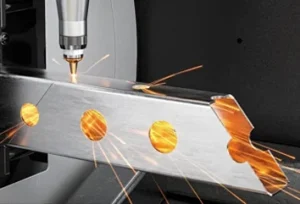
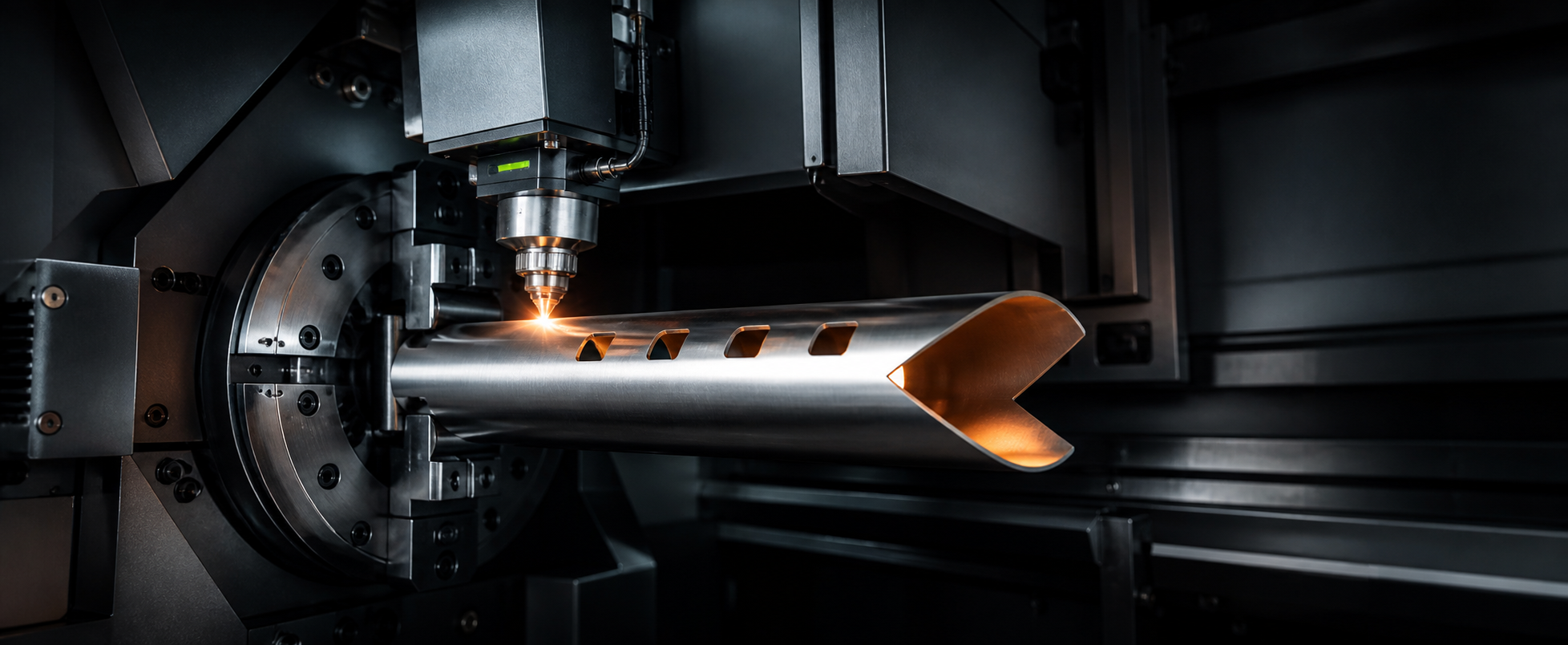
The profile is clamped, supported, fed and rotated while a programmed laser path creates the required end geometry and side-wall features. Depending on the equipment, process planning and profile, industry tube laser systems can process round, square and rectangular tubes as well as selected open profiles.
- Digital geometry controls the cutting path.
- Multiple features can be combined in one program.
- Rotation makes features on different faces possible.
- Actual bevel and 3D capability must be confirmed per machine.
Saw cutting
A band saw, circular saw or another mechanical sawing system separates the tube at a set length and angle. Correct blade selection, clamping, feed and support are important because thin-wall profiles can deform and poor cutting conditions can leave burrs or an inconsistent end.
- Efficient for repetitive straight cut-off work.
- Simple mitres can be economical.
- No laser heat-affected region at the cut.
- Side-wall features normally require another process.
Modern tube lasers are valuable because they can consolidate operations, not because every tube should be laser cut. Equipment manufacturers describe 2D and 3D systems for tubes and profiles, including straight edges, contours and selected bevel operations. These are industry capabilities; every supplier still needs to confirm its own machine range against the submitted drawing.
Straight Cuts, Mitres, Holes, Slots and Notches
Straight cut-to-length parts
If the part is simply a tube cut to length, a correctly selected saw can be difficult to beat. The process is direct, the programming requirement is low, and standard lengths can be produced with an appropriate stop or automated feed. Using a tube laser only for a simple cut-off may introduce setup and programming that the drawing does not need.
The decision changes when the cut end is only the first of several operations. If the saw-cut tube must then move to drilling, slotting and manual marking, the lowest cut-off price may not produce the lowest finished-part price.
Mitres and weld preparation
Both processes can produce angled ends, but the drawing should distinguish a basic mitre from a controlled bevel or weld-preparation feature. The achievable angle, edge condition and dimensional result depend on tube size, wall thickness, profile shape and equipment configuration. A 2D tube laser should not be assumed to provide the same capability as a 3D bevel-cutting head.
Holes and slots
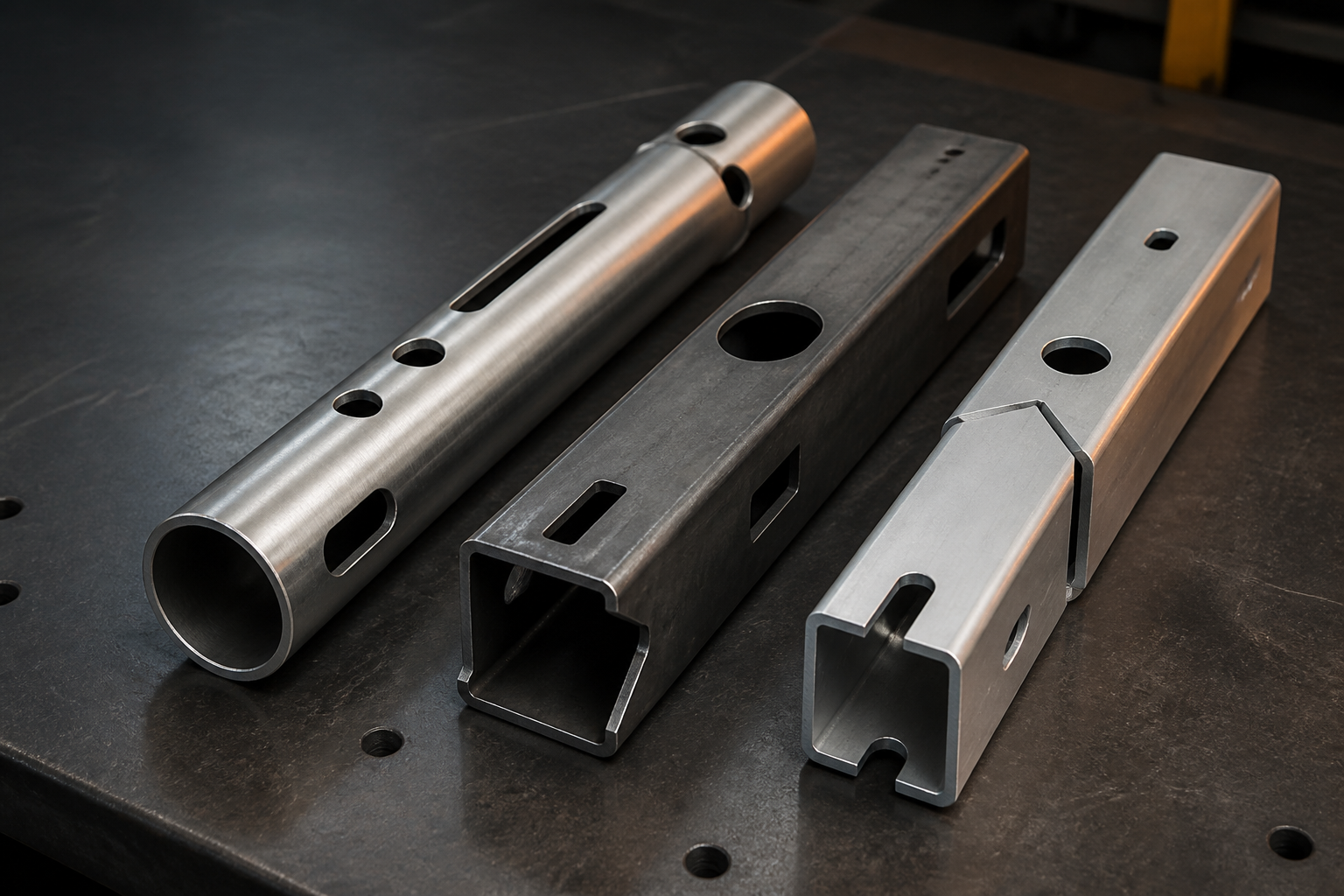
A tube laser can often cut side-wall holes and slots before the part leaves the machine. This is useful for fasteners, cable routes, locating tabs, ventilation features and assembly interfaces. However, the fact that a hole can be laser cut does not mean it is automatically suitable as a final precision bore.
- Small holes can be affected by wall thickness, piercing conditions and heat concentration.
- Features close to a tube end can leave a weak web or local distortion.
- Critical dowel, bearing or close-fit holes may need drilling, boring or reaming after cutting.
- Threaded holes usually require a subsequent tapping or thread-forming operation unless another validated method is specified.
Notches, fish-mouths and complex contours
Programmed notches and fish-mouth profiles can help one tube locate against another before welding. They may reduce manual marking, coping and fit-up work, particularly in frames and structural assemblies. The joint still needs a suitable gap, weld access and tolerance strategy; a visually perfect CAD intersection is not automatically an economical welded joint.
Features on multiple faces
Round tubes can rotate continuously, while square and rectangular profiles require the program to coordinate faces, corners and material orientation. Combining features on several faces can reduce fixture changes, but the result is also influenced by raw-tube straightness, twist, corner radius and weld-seam position.
Tolerance and End Quality
There is no single tolerance that accurately describes every tube-laser or saw-cut part. A useful drawing separates the characteristics that matter:
Tube laser results depend on machine positioning, chucking, support, thermal conditions and the profile itself. Saw-cut results depend on blade condition, feed, vibration, clamping, tube deformation and how the length is referenced. In both cases, the inspection method and datum scheme must match the functional requirement.
Machine resolution is not guaranteed finished-part accuracy
Do not copy a machine positioning figure into a production drawing. Ask the supplier to review critical characteristics in the context of material, profile, wall thickness, quantity and inspection method.
Edge and end condition
A saw can leave blade marks and burrs, while a laser can leave striations, dross or a thermally affected edge. Neither should be described as universally burr-free. If the end will be welded, inserted into another component, handled by an operator or left cosmetically visible, state the required finishing condition in the RFQ.
For a detailed breakdown of cut length, hole position, rotational alignment and profile-shape effects, read our tube laser cutting tolerance guide. For broader dimensional expectations across laser-cut parts, see our laser cutting tolerance guide for buyers.
Setup, Secondary Operations and Total Part Cost
Comparing only the hourly machine rate can lead to the wrong sourcing decision. A more useful model is:
Total part cost = material + setup/programming + cutting + secondary operations + deburring/finishing + inspection + scrap + handling and delivery
Tube laser cost drivers
- Review and preparation of the 3D model.
- Programming and feature count.
- Material, profile size and wall thickness.
- Loading, support and remnant handling.
- Cutting time, piercing and assist gas.
- Deburring, inspection and any required machining.
Saw-cut cost drivers
- Length and angle setup.
- Blade selection, wear and cutting time.
- Clamping and thin-wall deformation control.
- Deburring and end finishing.
- Separate drilling, milling, punching or marking.
- Extra fixtures, handling and inspection between operations.
A frame member with four holes, two slots and a notched end
A saw may provide the lowest cost for the initial cut-to-length operation. But if the part then requires two drilling setups, slot milling, manual notch preparation and repeated datum transfer, a tube laser may reduce the number of operations. The correct quotation should compare the finished member after all specified work, not only the first cut.
For the broader factors behind local laser-cutting quotations, see Laser Cutting Cost in Singapore.
Prototype, Small Batch and Production Quantities
| Order profile | Simple cut-to-length part | Part with multiple features |
|---|---|---|
| Prototype or one-off | Saw cutting may keep setup simple. | Tube laser can avoid several manual secondary operations, but programming still matters. |
| Small batch | Compare saw setup, cutting and deburring. | Feature consolidation can make tube laser attractive. |
| Recurring production | Automated sawing can be highly productive. | Repeatable digital processing and reduced handling can support consistency. |
| High-volume fixed geometry | Evaluate dedicated sawing and automation. | Compare laser with punching, dedicated tooling or a hybrid production cell. |
Quantity alone does not choose the process. Complexity and the number of secondary operations are equally important. A hybrid route may be best: saw stock into manageable lengths, laser-cut complex features, then machine only the bores or faces that require a precision finishing operation.
When Tube Laser Cutting May Not Be the Best Choice
Tube laser cutting should be evaluated carefully when:
- The part requires only a straight cut or simple mitre.
- The profile size, mass or wall thickness is outside the available machine range.
- The supplied tube has excessive bow, twist, ovality or inconsistent geometry.
- The final features require precision boring, reaming or extensive machining.
- The drawing prohibits the relevant thermal edge condition.
- The order quantity does not justify programming for a simple geometry.
- A dedicated saw, drill or punching route provides a more economical repeat process.
A capable supplier should be willing to recommend sawing or a hybrid route when it better fits the finished part. Process selection should follow the drawing, not the machine a supplier prefers to sell.
What to Include in a Tube Cutting RFQ
- Profile: round, square, rectangular or open profile.
- Material: exact grade where it affects function or processing.
- Outside size: diameter, width × height and relevant corner geometry.
- Wall thickness: nominal value and any governing material standard.
- Quantity: prototype quantity and expected repeat-production quantity.
- Features: straight cuts, mitres, holes, slots, notches and multi-face details.
- Critical requirements: identify only the dimensions and relationships that are functionally important.
- Secondary work: deburring, drilling, tapping, welding, marking or finishing.
- Inspection: state whether a dimensional report or specific measurement method is required.
- Files: provide a STEP model plus a PDF drawing for multi-face features and critical callouts.
Before finalising holes, slots, notches or joints, use our tube laser cutting design and DFM guide. For general file checks, see our CAD file preparation guide and STEP vs IGES vs DXF comparison. Tube frames for machinery and guarding can also be reviewed in the context of our industrial automation applications.
Frequently Asked Questions
Is tube laser cutting more accurate than saw cutting?
Not in every characteristic. Saw cutting can meet many cut-length and end-angle requirements. Tube laser cutting is useful when several programmed features must maintain a coordinated relationship, but finished-part accuracy still depends on raw profile condition, setup, support, cutting parameters, datum strategy and inspection.
Is tube laser cutting always more expensive?
No. The laser operation may carry programming and machine costs, but it can reduce drilling, milling, punching, manual marking, fixtures and repeated handling. Compare the total cost after all required operations.
Can a tube laser cut round, square and rectangular tubes?
Industry tube laser systems can process several closed and open profile types, but the supported material, outside size, length, wall thickness and geometry vary by machine. Submit the actual profile specification for confirmation.
Does tube laser cutting eliminate drilling?
It can produce many clearance holes, slots and cut-outs directly. Precision bores, dowel holes, bearing fits, tapped holes and features with special surface requirements may still need drilling, boring, reaming or tapping.
Which process is better for small quantities?
Saw cutting can be economical for small quantities of simple cut-to-length parts. A tube laser may be economical for complex low-volume parts when it replaces several manual operations. Geometry matters as much as quantity.
What files are required for tube laser cutting?
For parts with features on multiple faces, provide a STEP model and a PDF drawing showing critical dimensions, datums and inspection needs. A simple saw-cut part may only require the profile specification, cut length, angle and quantity.
Sources and Technical Context
- Bystronic: tube and profile laser processing, profile types and 2D/3D cutting context
- Bystronic case context: beveling, slotting and tabbing in tube processing
- BLM Group: overview of industrial tube, bar and profile laser systems
Review Your Tube Part Before Quotation
Send the profile specification, STEP model, PDF drawing and quantities. Lumen Future can review whether tube laser cutting, saw cutting, secondary machining or a combined route is appropriate for the finished part.