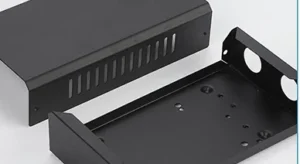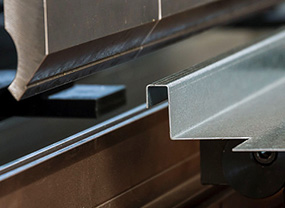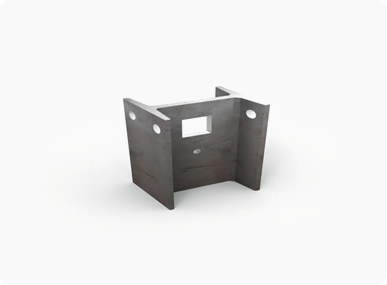
Choose laser cutting for flat 2D profiles, through-holes and sheet-metal parts where speed, nesting and low setup cost matter. Choose CNC machining for three-dimensional features, precision bores, threads, pockets, sealing faces and dimensions tied closely to defined datums. Use both when a laser-cut blank can reduce material and machining time before critical features are finished by CNC.
Laser cutting and CNC machining overlap on some plate components, but they are not direct substitutes for every metal part. Laser follows a two-dimensional path through sheet or plate. CNC milling and turning remove material with cutting tools to create controlled surfaces and features at different depths and orientations.
The most economical process route often divides the drawing by function. Laser completes the outside profile and general through-features. Machining finishes a bearing bore, locating hole, threaded feature, sealing face or datum. This avoids spending precision machining time on geometry that a laser can produce efficiently.
What Does “CNC” Mean in This Comparison?
CNC means computer numerical control. It describes how machine motion is controlled, not one particular manufacturing process. A laser cutter, press brake, milling machine and lathe can all be CNC-controlled.
In normal procurement language, “laser cutting vs CNC machining” usually means comparing laser profile cutting with CNC milling or turning:
Laser cutting
Cuts flat profiles and through-features from sheet or plate. Efficient nesting can produce many parts in one setup.
CNC milling
Uses rotating tools to machine faces, pockets, slots, holes, counterbores and three-dimensional surfaces.
CNC turning
Rotates the workpiece to produce shafts, sleeves, diameters, shoulders, grooves and threads.
Laser Cutting vs CNC Machining at a Glance
| Decision factor | Laser cutting | CNC machining |
|---|---|---|
| Primary geometry | Flat 2D profiles | 2D, 2.5D and 3D geometry |
| Typical stock | Sheet and plate | Plate, block, bar, casting, forging or pre-cut blank |
| Feature depth | Normally through-cut features | Blind holes, pockets, steps, grooves and surfaces |
| Threads | Cannot form a complete machined thread | Can drill and tap, thread mill or turn threads |
| Precision bores | Can create through-holes subject to thermal-cut limits | Can drill, bore or ream controlled fits |
| Internal corners | Can produce small profile radii | Internal radius is limited by tool geometry |
| Surface type | Thermal cut face | Machined face with tool marks and specified finish |
| Thermal effects | Local heat-affected region may be present | No thermal-cut HAZ, but cutting heat and residual stress still need control |
| Workholding | Sheet support and nesting are central | Datum location, clamping, rigidity and access are central |
| Setup | Programming, nesting, focus and gas | CAM, tools, fixtures, offsets and setup sequence |
| Production strength | Fast flat profiles and many nested parts | Critical features, three-dimensional detail and controlled interfaces |
| Material utilisation | Efficient sheet nesting | May generate significant chips when starting from solid stock |
| Typical parts | Brackets, panels, shims, covers and flat plates | Fixtures, housings, shafts, bearing blocks and precision interfaces |
Choose Laser Cutting for Flat Metal Parts
Laser cutting is normally the first process to evaluate when the part can be represented primarily as a flat outline with through-features. Suitable examples include:
- mounting brackets and connection plates;
- machine panels and electrical faceplates;
- shims, gaskets and spacers;
- covers, guards and enclosure blanks;
- flat flanges and reinforcement plates;
- parts that will be formed by CNC bending;
- nested production batches with repeated profiles.
Laser has little reason to make multiple cutting passes at different depths because it normally cuts through the sheet. Its commercial advantage comes from rapid non-contact profiling, many features in one program and efficient nesting. Review our laser metal cutting service in Singapore for the applicable material and drawing workflow.
Choose CNC Machining for Functional Precision Features
CNC machining becomes necessary when the drawing contains geometry a two-dimensional thermal cut cannot create or control appropriately:
- blind pockets and stepped depths;
- threaded holes and thread forms;
- counterbores, countersinks and spot faces;
- precision dowel, bearing or locating bores;
- sealing faces and controlled surface finishes;
- multi-face datum relationships;
- three-dimensional contours;
- shafts, sleeves and rotational geometry.
Machining can control local functional features more tightly than thermal profile cutting when the machine, tooling, setup and inspection are capable. It should not be used simply because a dimension looks important; function, fit and the downstream assembly should justify the extra process.
When Laser Cutting and CNC Machining Work Together
A hybrid route is often the best economic answer for a large plate-shaped part with a complex perimeter and a small number of precision interfaces.
Typical hybrid parts include:
- machine baseplates with precision dowel holes;
- motor mounting plates with a controlled register bore;
- automation plates with many general holes and a few bearing fits;
- large aluminium plates requiring local pockets or sealing faces;
- stainless components with a laser profile and machined datum surfaces;
- near-net blanks that receive final multi-axis machining.
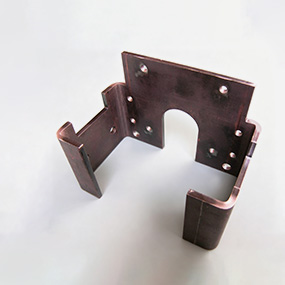
The laser removes peripheral material quickly. CNC time is then reserved for features that create functional value. This can reduce roughing time and chip volume compared with machining the entire profile from a rectangular block.
If the blank is very thick or cannot accept a thermally affected cut edge, compare the combined machining route with a laser or waterjet pre-cut blank before finalising the process.
Machining Allowance Cannot Be a Universal Number
A near-net blank must leave enough material for the machining supplier to establish a clean, stable final surface. Too little allowance can leave laser-cut edge, taper, flatness variation or part movement inside the finished geometry. Too much allowance creates unnecessary machining time and difficult workholding.
The required allowance depends on:
- material grade, temper and thickness;
- part size and shape;
- laser edge condition and heat effect;
- plate flatness and residual stress;
- datum plan and workholding method;
- roughing and finishing sequence;
- final tolerance and surface finish;
- whether the feature is an edge, face, bore or pocket.
Datum Transfer and Workholding
The transition from laser table to machining fixture needs a repeatable location strategy. A rough laser hole may be useful for handling or approximate location, but it should not automatically become the final datum for a precision machined pattern.
Review:
- which faces and holes establish the final coordinate system;
- whether sacrificial stock is needed for clamping;
- where clamps can sit without obstructing tool access;
- whether reference tabs or temporary features are allowed;
- how the blank is probed or indicated;
- whether the part requires two or more machining setups;
- how flatness is controlled after cutting and unclamping.
Machine accuracy alone does not fix poor workholding. Haas maintenance and accuracy guidance explicitly calls out fixture security, tool length, tool-holder runout and coolant as factors in machining results. The part, fixture, tools and machine must be treated as one system.
Tolerance: Profile Accuracy vs Functional Accuracy
It is misleading to publish one number for laser and another for all CNC machining. A laser-cut profile may be entirely adequate for a bracket outline, while a machined bore may be required for a bearing fit. The processes are controlling different functions.
| Drawing feature | Recommended route | Reason |
|---|---|---|
| General outer profile | Laser | Efficient 2D cutting and nesting |
| General mounting hole | Laser, subject to size and thickness review | May meet normal clearance function without secondary work |
| Precision locating hole | Laser pilot or blank plus CNC boring/reaming | Controls size and datum relationship |
| Threaded hole | Drill and tap or thread mill after blanking | Laser does not generate a complete thread form |
| Bearing bore | CNC machining | Fit, roundness and surface condition are functional |
| Sealing face | CNC machining | Flatness and surface finish require controlled material removal |
| Blind pocket or step | CNC machining | Feature does not pass through the material |
| Complex perimeter with few precision features | Laser plus CNC | Separates economical profiling from critical finishing |
A machine’s positioning specification is not a guaranteed part tolerance. Laser results depend on material, focus, gas, heat, geometry and inspection. Machining results depend on machine condition, tools, tool deflection, runout, workholding, thermal state, setup and measurement. See our laser cutting tolerance guide for drawing-specific profile considerations.
Flatness and Residual Stress
Sheet and plate contain residual stresses from rolling, levelling, heat treatment and prior processing. Cutting a profile can release those stresses and change flatness. Removing material during CNC roughing can also cause movement, especially in asymmetric parts.
For a precision plate, the process plan may need:
- material condition and flatness requirements;
- symmetric or staged roughing;
- resting, stress relief or intermediate inspection where justified;
- controlled clamping that does not force a distorted part flat;
- final finishing after the part reaches a stable condition.
Do not expect a tight final flatness requirement to appear automatically from either a laser table or one machining pass. The requirement must be designed into the route.
Surface Finish and Edge Function
| Surface or edge | Laser-cut condition may be suitable | Machining is usually considered |
|---|---|---|
| General bracket perimeter | Yes, after any required deburring | Only if fit or appearance requires it |
| Bending edge | Often, subject to burr and crack risk | Rarely for ordinary sheet-metal forming |
| Weld preparation | May be suitable after edge review | For controlled bevel, land or critical joint fit |
| Sliding or bearing interface | Usually not as a final functional surface | Yes |
| Gasket or O-ring sealing face | Usually not as the final controlled face | Yes |
| Optical or precision mounting datum | Not normally the final datum | Yes, with specified inspection |
Surface roughness should be specified only where it supports function. Do not apply a machining finish requirement to every face of a fabricated part; unnecessary finishing increases cost and may complicate inspection.
Laser Cutting vs CNC Machining Cost
Laser is normally more economical when the part is flat, profiles can be nested, quantities are repeated and the drawing does not require machined functional surfaces. CNC setup and cycle time are difficult to justify for a simple flat outline.
CNC machining is not an optional premium when the part requires precision bores, threads, pockets, multiple datums or controlled finishes. Eliminating it would change the part function rather than merely reduce cost.
The hybrid route is attractive when most material removal is two-dimensional and only a limited number of features require machining. For broader laser quotation factors, see our laser cutting cost guide.
Material Choice Can Change the Route
Aluminium 5052 and 6061
5052 is commonly selected for sheet-metal cutting and bending, while 6061 is widely used for machined plates and blocks. That does not make one alloy automatically better. Strength, temper, corrosion, bending, machining, welding and stock form all matter. Our 6061 vs 5052 aluminium guide explains the sheet-metal selection context.
Stainless steel
Flat stainless panels, brackets and covers can suit laser cutting. Precision fixture plates, sealing faces and locating bores may need CNC finishing. Passivation, polishing and dimensional inspection should be sequenced around the final machined surfaces.
Mild and carbon steel
Laser is productive for structural profiles, connection plates and welded blanks. Machine bases, tight bores and controlled reference surfaces may require machining allowance and a stable finishing route. Oxygen-cut edges should be reviewed if they will be machined, welded or coated.
File Preparation for Laser and CNC
| Information | Laser cutting | CNC machining |
|---|---|---|
| Primary geometry | DXF or DWG for clean 2D profiles | STEP, Parasolid or supplier-approved 3D model |
| Engineering drawing | Material, thickness, critical profile tolerances and finish | Datums, GD&T, threads, fits, surface finish and inspection |
| 3D model use | Useful for assembly, bending and overall intent | Central to CAM and multi-surface geometry |
| Nominal geometry | Do not pre-offset for kerf unless requested | Do not modify nominal features for cutter compensation |
| Machining allowance | Show the agreed blank geometry separately | Define with the machining supplier and datum plan |
Do not rely on an STL mesh as the only precision manufacturing file. Read our guides to STEP vs IGES vs DXF and CAD file preparation for laser cutting.
A Combined Manufacturing Workflow
Common Singapore Metal-Part Applications
| Part | Recommended route | Reason |
|---|---|---|
| Flat sensor bracket | Laser | Two-dimensional profile and ordinary mounting holes |
| Bent equipment enclosure | Laser plus CNC bending | Sheet profile followed by forming, not milling |
| Precision fixture block | CNC machining | Multiple faces, holes, datums and finish requirements |
| Motor mounting plate | Laser plus CNC critical bore | Economical outer profile with controlled register feature |
| Bearing housing | CNC machining | Bore, fit, alignment and surface function |
| Large automation baseplate | Laser blank plus CNC finishing | Large profile with selected precision holes and faces |
| Control panel | Laser | Cut-outs, holes and panel geometry |
| Shaft or sleeve | CNC turning | Rotational diameters, shoulders and threads |
| Welded-frame connection plate | Laser; machine critical features if required | Fabricated profile with function-based finishing |
This routing logic is especially relevant to automation and semiconductor equipment, where a large fabricated component may include only a few high-precision interfaces. See our guide to laser cutting for industrial automation parts and the Singapore sheet-metal supplier guide.
RFQ Checklist
Send or identify:
- 3D model and revision
- 2D engineering drawing
- Material grade and condition
- Stock form and thickness
- Quantity and repeat forecast
- Laser-finished features
- CNC-finished features
- Datums and GD&T
- Threads and fits
- Surface finish
- Flatness requirement
- Machining allowance
- Workholding restrictions
- Heat-treatment or stress-relief need
- Surface treatment sequence
- Inspection and report scope
- Packaging and Singapore delivery
- Responsibility for each supplier handoff
Frequently Asked Questions
Is CNC machining more accurate than laser cutting?
CNC machining can generally control critical bores, faces and datum-related features more tightly than thermal profile cutting when the machine, tooling, workholding and inspection are capable. Actual tolerance is feature- and supplier-specific.
Can laser cutting replace CNC milling?
Only for features that are fundamentally flat and through-cut. Laser cannot create blind pockets, machined threads, controlled sealing faces or general three-dimensional geometry.
Can laser-cut holes be tapped directly?
Some suitable holes can be drilled or tapped after cutting, but thread quality depends on hole size, edge condition, material and required class. Critical threads normally receive a controlled drilling and tapping route.
Should precision holes be laser cut or CNC machined?
Laser may create the blank or pilot feature, while boring, reaming or another machining operation establishes a critical size, roundness and datum relationship. The drawing function should decide.
Is it cheaper to laser cut or CNC machine a metal part?
Laser is usually less expensive for flat sheet profiles. CNC machining costs more setup and machine time but is necessary for three-dimensional and precision features. A hybrid route can minimise total cost.
How much machining allowance should a laser-cut blank have?
There is no universal allowance. The machining supplier should set it after reviewing material, thickness, part size, flatness, workholding, laser edge and final tolerance.
Can the same STEP file be used for laser and CNC quotation?
A STEP model is useful for both, but laser suppliers often also need a clean DXF for the flat profile and a drawing with thickness and tolerances. Machining suppliers need the 3D model plus datum, fit, thread and finish information.
Technical references
Review Your Laser-Cut Blank
Send the drawing, material, thickness, quantity and identify any critical features intended for later machining. We can review laser-cut blank feasibility and define the appropriate cutting scope.