For most Singapore sheet metal projects, the choice between aluminium 5052-H32 and 6061-T6 comes down to what you need the part to do. 5052 wins on formability and corrosion resistance — the right pick for marine work, F&B equipment, electronics enclosures, and anything with tight bends or exposure to humidity. 6061 wins on strength and machinability — the right pick for structural brackets, CNC-machined parts, frames, and anything load-bearing. They are not interchangeable. Substituting 6061 for 5052 on a tight-bend enclosure usually cracks the bends; substituting 5052 for 6061 on a load-bearing bracket may deform under stress. A counter-intuitive fact worth knowing: 5052 actually has higher fatigue strength than 6061 by roughly 25%, which is why it’s chosen for parts under repeated stress.
A typical scenario in Singapore industrial work: an engineer redesigns an outdoor stainless steel enclosure to aluminium to save weight and cost. They specify 6061-T6 because “it’s the strongest aluminium grade.” The parts come back cut beautifully, but during forming the bends develop hairline cracks. After six months of salt-laden coastal air, the cracks have propagated and the enclosure needs replacement. The correct choice all along was 5052-H32 — the grade most engineers reach for second, but the right answer for nine out of ten outdoor sheet metal enclosures in Singapore.
Aluminium 6061 and 5052 look similar on a spec sheet, but they behave very differently in the workshop and in the field. This guide compares them from the perspective that matters most for Singapore industrial work: how they behave under laser cutting, bending, welding, machining, and the local climate. It’s written for mechanical engineers, product designers, QA teams, and procurement officers who need to pick the right grade the first time.
For stainless steel grade selection (the other major sheet metal decision), see our SS304 vs SS316 in Singapore guide. For the broader laser cutting picture, our complete laser cutting buyer’s guide covers the full process landscape.
The Core Difference in One Sentence
Before the deep comparison, here’s the one-line decision tree most projects can use as a starting point:
| If your part needs… | Choose | Why |
|---|---|---|
| Tight bends or complex forming | 5052-H32 | Ductile, won’t crack on small radii |
| Marine / outdoor / humid exposure | 5052-H32 | Superior corrosion resistance |
| Welded assemblies (tanks, enclosures) | 5052-H32 | Retains strength near welds |
| Heavy CNC machining (>50% material removal) | 6061-T6 | Cleaner chips, better finish, faster cycles |
| Structural load-bearing parts | 6061-T6 | Higher tensile and yield strength |
| Anodised cosmetic finish | 6061-T6 | More uniform anodising appearance |
The mental shortcut: Will you bend it? Pick 5052. Will you machine it? Pick 6061. Outdoors in Singapore? Default to 5052. The rest of this guide explains why these defaults exist, when to override them, and how to spot a wrong grade choice before it becomes a production problem.
Chemical Composition and Why It Matters
The two grades share aluminium as the base but differ in their alloying elements:
| Element | 5052-H32 | 6061-T6 | Practical Effect |
|---|---|---|---|
| Magnesium (Mg) | 2.2–2.8% | 0.8–1.2% | 5052’s high Mg → strong corrosion resistance |
| Silicon (Si) | ≤0.25% | 0.4–0.8% | 6061’s Si forms magnesium silicide → enables heat treatment |
| Copper (Cu) | ≤0.1% | 0.15–0.4% | 6061’s Cu boosts strength but reduces marine corrosion resistance |
| Chromium (Cr) | 0.15–0.35% | 0.04–0.35% | Both gain stress-crack resistance |
| Strengthening method | Cold working only | Heat treatment + ageing | Determines available tempers and weldability |
The takeaway: 5052 is engineered around magnesium for corrosion resistance and ductility. 6061 is engineered around magnesium-silicon-copper for strength through heat treatment. The copper in 6061 is what makes it stronger — but it’s also what makes it less suitable for prolonged saltwater exposure.
Mechanical Properties: The Numbers
The headline numbers favour 6061 in most categories — but one important property runs the other way.
Standard industrial reference values
| Property | 5052-H32 | 6061-T6 | Winner |
|---|---|---|---|
| Ultimate tensile strength | 210–260 MPa | 290–310 MPa | 6061 (+30%) |
| Yield strength | ~130 MPa | ~240 MPa | 6061 (+85%) |
| Fatigue strength | 115–125 MPa | 96–97 MPa | 5052 (+25%) ⭐ |
| Hardness (Brinell) | 60–61 HB | 93–95 HB | 6061 (+55%) |
| Density | 2.68 g/cm³ | 2.70 g/cm³ | 5052 (slightly lighter) |
| Elongation | ~12% (good ductility) | ~10% (moderate) | 5052 (better forming) |
| Minimum bend radius | 0.5–1× thickness | 2–3× thickness | 5052 (much tighter bends) |
The fatigue strength point is worth dwelling on. For parts under repeated cyclical stress — vibration, flexing, pulsing pressure — 5052 actually outperforms 6061 despite being the “weaker” alloy. This is why marine fuel tanks, truck trailers crossing rough roads, and pressure-cycling vessels often specify 5052 even when the static strength of 6061 would suffice.
Static strength matters when a part holds a constant load (structural brackets, fixed frames). Fatigue strength matters when the load varies over time. Most real-world parts experience both — but the dominant failure mode determines which property matters most.
Corrosion Resistance: Singapore’s Killer Climate
Singapore’s environment is among the toughest in the world for unprotected metal. Year-round relative humidity averages around 84%, salt-laden air affects everything within several kilometres of the coast, and warmth accelerates oxidation chemistry. For outdoor or marine-exposed aluminium parts, corrosion resistance often matters more than strength.
Practical comparison in Singapore conditions:
| Environment | 5052-H32 Performance | 6061-T6 Performance |
|---|---|---|
| Indoor air-conditioned | Excellent | Excellent |
| Indoor humid (warehouse, kitchen) | Excellent | Good |
| Outdoor non-coastal | Excellent | Good (with anodising/coating) |
| Outdoor coastal (within 5 km of sea) | Excellent | Fair (requires protection) |
| Direct marine immersion | Excellent (marine-grade) | Poor — pitting expected |
| Chemical processing (food/pharma) | Excellent | Variable depending on chemical |
For Singapore F&B equipment manufacturers, marine workshops in Tuas and Jurong Island, and offshore service contractors, the default is 5052 unless there’s a specific reason to override it. The cost premium (if any) is typically offset within months by avoided coating, recoating, and replacement labour.
Formability: Why 6061-T6 Cracks on Tight Bends
This is the most common surprise for engineers new to 6061. The T6 heat treatment that makes the alloy strong also makes it more brittle — and brittle metal cracks when forced into tight bends.
Specifying 6061-T6 for an Enclosure with 90° Bends
An engineer designs a sheet metal enclosure with sharp 90° bends at a small radius. Choosing 6061-T6 for “extra strength” results in hairline cracks at the outer surface of every bend during press brake forming. The parts may pass initial inspection but fail in service when the cracks propagate. Switch to 5052-H32 or design with much larger bend radii to use 6061.
| Sheet Thickness | 5052-H32 Min. Bend Radius | 6061-T6 Min. Bend Radius |
|---|---|---|
| 1.0 mm | 0.5–1.0 mm | 2.0–3.0 mm |
| 1.5 mm | 0.75–1.5 mm | 3.0–4.5 mm |
| 2.0 mm | 1.0–2.0 mm | 4.0–6.0 mm |
| 3.0 mm | 1.5–3.0 mm | 6.0–9.0 mm |
| 5.0 mm | 2.5–5.0 mm | 10.0–15.0 mm |
The design implication: if your enclosure design has tight internal corners, 5052 is the practical answer. If you must use 6061 for strength reasons, design the bends with larger external radii — or consider machining the part from a thicker block instead of forming it from sheet. For more on bending tolerance and design rules, see our CNC bending tolerance guide.
Machinability: The 6061 Advantage
If your part involves heavy CNC machining — pockets, threads, intricate features, large material removal — 6061 is the practical default. The same properties that make 5052 forgiving in forming make it problematic on a CNC mill.
What CNC operators love
Short, broken chips clear easily. Higher cutting speeds achievable. Stable cuts with tight tolerances (±0.025 mm routine). Smooth surface finish straight off the tool. Longer tool life. Lower scrap rate.
The “gummy” problem
Long stringy chips that wrap around tooling. Material’s softness causes built-up edge on cutting tools. Lower cutting speeds required to prevent overheating. Surface finish often needs additional polishing. Burrs require manual deburring. Slower cycle times, more tool wear.
For sheet metal parts that are predominantly cut-and-bent (with minimal milling), this matters less. For parts that require machined features after laser cutting — drilled holes, threads, milled pockets, tight-tolerance interfaces — the 6061 advantage becomes significant. For post-processing considerations more broadly, see our polishing & deburring guide.
Laser Cutting Both Grades: What to Expect
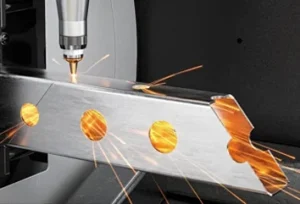
Both 5052 and 6061 are cut industrially with fiber laser — the 1064 nm wavelength is well absorbed by aluminium of all alloys. But the two grades behave differently at the cut zone, and understanding the difference helps you specify quotes correctly.
Softer, slightly slower, manageable burr
5052’s relatively soft and ductile nature means the molten metal at the cut zone flows more readily, sometimes leaving slightly larger bottom burrs than 6061. Nitrogen assist gas is preferred to prevent oxidation and improve edge cleanliness. Standard deburring after cutting is often advisable for visible-surface or assembly-critical applications.
Harder, faster, cleaner edge
6061’s higher hardness produces cleaner chip evacuation at the cut zone, resulting in sharper edges and minimal burr. One caveat: the heat-affected zone immediately adjacent to the laser cut can experience localised annealing — meaning the T6 properties are partially lost within roughly 0.2–1 mm of the cut edge. For most applications this is irrelevant; for parts where the cut edge is also a stress-bearing surface, it’s worth considering.
Both grades use fiber laser cutting in Singapore industrial workflows — for the wavelength logic and why fiber is the right choice for aluminium, see our fiber vs CO₂ vs UV laser selection guide.
Welding Performance
This is one of the clearest functional differences between the two grades — and one of the most consequential for assembly-heavy projects.
6061-T6 Loses ~40% Strength Near Welds
The T6 heat treatment that gives 6061 its high strength is destroyed by welding heat. The heat-affected zone (HAZ) around a weld on 6061-T6 typically retains only about 60% of the original strength. For load-bearing welded assemblies, this strength loss must be designed around — either by re-heat-treating the entire part after welding, by using more material to compensate, or by avoiding welds in stress-critical locations.
5052-H32 has no such issue. Because it isn’t heat-treatable in the first place, welding doesn’t degrade its strength dramatically — the heat-affected zone retains roughly 90% of base metal strength. This makes 5052 the practical choice for:
- Welded tanks and reservoirs (fuel, water, chemical storage)
- Welded enclosures and chassis where the welds carry loads
- Marine assemblies where the weld zone faces both stress and corrosion
- Pressure vessels and pressure-cycling components
6061-T6 remains the right choice for welded structures only when the assembly will be re-heat-treated as a unit after welding (rare outside aerospace) or when welds are non-load-bearing. For more on welding stainless steel and the comparison between laser welding and TIG, see our laser welding vs TIG welding guide.
Anodizing & Surface Finishing
For parts where appearance matters — visible enclosures, branded products, decorative architectural elements — surface finishing behaviour matters as much as mechanical properties.
| Surface Process | 5052-H32 Result | 6061-T6 Result |
|---|---|---|
| Clear anodising | Slight yellow/brownish tint possible | Uniform, neutral colour |
| Coloured anodising | Possible colour shift, less consistent | Uniform, predictable colour |
| Hard-coat anodising | Acceptable but may appear darker | Standard reference for hard-coat appearance |
| Brushed finish | Excellent, smooth grain | Excellent |
| Mechanical polishing | Adequate (limited by gumminess) | Easier to reach mirror finish |
| Powder coating | Excellent adhesion | Excellent adhesion |
| Painting | Excellent adhesion (clean surface) | Excellent adhesion |
The takeaway: if your part will be anodised in a visible colour, choose 6061. Powder coating and painting work equally well on both. For natural mill finish or brushed appearance, both grades work — but 6061 polishes more easily to mirror finish.
Singapore Applications: Industry Mapping
Across Singapore’s main industrial sectors, the grade selection follows fairly clear patterns:
Marine & Offshore (Tuas, Jurong Island)
Default: 5052 (sometimes 5083 for very demanding marine work). Boat fuel tanks, deck structures, hull plating, offshore equipment. The combination of saltwater exposure, fatigue cycling, and welded construction makes 5052 the practical choice. PSA, Sembcorp Marine, and Keppel-aligned workshops use 5052 extensively for these reasons.
Food & Beverage Equipment
Default: 5052. Food processing tanks, conveyor systems, hopper bodies, hygienic equipment. The combination of cleaning chemical exposure, frequent washdowns, and welded fabrication aligns with 5052’s strengths. 6061 appears for support frames and mounting hardware that don’t contact food.
Electronics & Industrial Enclosures
Default: 5052. IP-rated outdoor cabinets, control boxes, custom electronics housings. Tight bends, possible outdoor mounting, and weld-sealed seams all favour 5052.
Semiconductor Equipment (Pasir Ris, Jurong)
Default: 6061. Precision-machined parts, vacuum chamber components, jigs and fixtures, equipment frames. Indoor cleanroom environment means corrosion isn’t the dominant concern; heavy machining and dimensional stability are. 6061-T6 is the workshop standard.
Architecture & Building Products
Mixed — depends on exposure. Interior decorative panels and anodised cladding: 6061 for finish quality. Exterior facade elements, balcony components, anything exposed to coastal weather: 5052 for corrosion resistance.
Aerospace & Drone Components
Default: 6061 (sometimes 7075 for high-performance). Structural strength-to-weight is the dominant requirement. Marine corrosion is not a concern for most aerospace work, so 6061’s properties win.
Industrial Machinery & Tooling
Default: 6061. Frames, brackets, machined fittings, jigs. Strength and dimensional stability matter more than corrosion resistance in indoor industrial environments.
Cost & Availability in Singapore
Raw material prices for 5052 and 6061 are similar — within a small percentage of each other on a per-kilogram basis. The bigger cost drivers are availability, processing method, and lifecycle factors.
| Cost Factor | 5052-H32 | 6061-T6 |
|---|---|---|
| Raw material price (per kg) | Similar to 6061 | Similar to 5052 |
| Local Singapore stock availability | Common in sheet form; less common in plate/bar | Widely available in sheet, plate, bar, extrusion |
| Lead time for non-stock thickness | 2–6 weeks (imported) | 1–4 weeks (more local options) |
| Laser cutting cost | Slightly higher (more deburring) | Standard |
| Bending cost | Lower (forgiving material) | Higher (larger bends, may crack) |
| Machining cost | Higher (slower, more tool wear) | Lower (faster, easier) |
| Welding cost | Standard (no post-treatment needed) | Higher if T6 needs restoration |
| Lifecycle / replacement cost in marine environment | Significantly lower | Higher (may need recoating or replacement) |
For total project economics, look at the dominant processing step. Mostly bending and forming → 5052 wins on total cost even if raw material is similar. Mostly machining → 6061 wins on total cost despite similar raw material. Outdoor/marine deployment → 5052 wins on lifecycle cost by avoiding coating maintenance and premature replacement. For broader cost benchmarks across processes, see our laser cutting cost guide.
Decision Matrix: 5 Questions to Pick the Right Grade
Run your project through these five questions in order. The first “Yes” usually settles the decision; subsequent questions verify or refine it.
- Does the design have bends with radius less than 2× material thickness?
Yes → 5052 (6061 will likely crack). No → Continue to Q2. - Will the part be exposed to marine, coastal, or chemically aggressive environments?
Yes → 5052 (6061 needs protective coating, adds cost and maintenance). No → Continue to Q3. - Is the part welded and load-bearing?
Yes → 5052 (6061-T6 loses 40% strength near welds). No → Continue to Q4. - Does the part require heavy CNC machining (more than 50% material removal)?
Yes → 6061 (faster cycles, cleaner finish, lower scrap). No → Continue to Q5. - Is anodised cosmetic appearance critical?
Yes → 6061 (more uniform colour). No → 5052 is the safer default for general sheet metal work.
For complex assemblies that have a mix of needs — say, a welded outdoor enclosure with internal machined mounting fixtures — the answer is often to use both: 5052 for the welded enclosure body, 6061 for machined brackets and inserts that bolt in. This hybrid approach is common in Singapore industrial fabrication and avoids forcing one grade to do everything.
See Both Grades Being Processed
Watch our process videos showing laser cutting, bending, and finishing on both 5052 and 6061 — useful for visualising how each grade behaves before committing to your design.
Watch Videos →Frequently Asked Questions
Can I substitute 5052 for 6061 (or vice versa) without redesigning?
Generally no — direct substitution is risky. Using 5052 instead of 6061 on load-bearing parts can result in deformation under stress (5052 yield strength is roughly 45% lower). Using 6061 instead of 5052 on tight-bend or welded marine parts can cause cracking at bends and accelerated corrosion in service. Any substitution should be re-validated by an engineer with full knowledge of the load case and service environment.
Which aluminium grade is better for outdoor enclosures in Singapore?
5052-H32, almost without exception. Singapore’s high humidity (84% annual average) plus salt-laden coastal air make corrosion the dominant concern for outdoor parts. 5052’s higher magnesium content and absence of copper give it dramatically better resistance to this combination than 6061. The cost premium (if any) is typically recovered within months by avoiding the recoating and replacement labour 6061 would require.
Is 5052 really lighter than 6061?
Marginally yes, but the difference is usually not significant for design purposes. 5052 has a density of approximately 2.68 g/cm³ versus 2.70 g/cm³ for 6061 — about 0.7% lighter. For most projects this isn’t a deciding factor; choose between the two on mechanical and corrosion considerations rather than weight.
Why does 6061-T6 crack when I bend it tightly?
The T6 heat treatment that gives 6061 its strength also reduces its ductility — making the alloy more brittle when forced into tight bends. The outer surface of a tight bend experiences high tensile strain, and 6061-T6 doesn’t elongate enough to accommodate that strain without cracking. Practical minimum bend radius for 6061-T6 is roughly 2-3× the material thickness; below that, cracking risk increases sharply. For sharper bends, switch to 5052-H32 (which can typically bend to 0.5-1× thickness) or design around larger radii.
Which grade is cheaper to laser cut in Singapore?
6061-T6 typically cuts slightly faster and with less burr formation than 5052-H32, marginally favouring 6061 on a per-part cutting basis. However, for sheet metal projects that involve bending after cutting, 5052’s bending economy usually outweighs the small cutting difference. The honest answer: cutting cost is rarely the dominant factor — choose grade based on the part’s structural and service requirements, and let the cutting cost difference fall where it may.
Can both grades be anodised the same way?
Both can be anodised, but the appearance differs. 6061-T6 produces more uniform anodising results with predictable colour — preferred when cosmetic appearance matters. 5052-H32 can develop slight yellowish or uneven tinting due to its higher magnesium content, more noticeable on hard-coat anodising. For coloured or visible decorative anodising, 6061 is the safer choice. For natural mill finish, brushed finish, or powder coating, both grades work equally well.
More Material Reference
Visit our Download Center for material capability brochures, common stainless and aluminium grades we work with, and project reference documents — useful for scoping your next sheet metal project.
Visit Download Center →Not Sure Which Grade Fits Your Project?
Three takeaways from this guide:
- 5052-H32 wins on formability, corrosion, and welded structures — the right choice for marine, F&B, outdoor enclosures, and anything with tight bends.
- 6061-T6 wins on strength, machinability, and cosmetic anodising — the right choice for structural brackets, CNC-machined parts, and indoor industrial work.
- They are not interchangeable. Substitution without re-engineering risks cracked bends, weld failures, or load-related deformation. When in doubt, ask before committing.