Laser cutting and CNC turret punching can both turn flat sheet into production parts, but their economics are driven by different features. This laser cutting vs punching guide compares the complete manufacturing route: laser cutting is highly flexible for changing and irregular profiles, while turret punching can be extremely productive for repeated standard holes and can add formed features that a cutting laser cannot create by itself.
Quick answer
Choose laser cutting when the part has free-form contours, mixed hole shapes, frequent revisions or a low-volume product mix that does not justify special tools. Evaluate turret punching when the sheet contains many repeated standard holes or when louvers, knockouts, embosses, extrusions or other compatible formed features can be produced in the same setup.
Quantity alone does not decide the process. Compare available tooling, hit count, cutting and piercing time, sheet handling, edge requirements and the secondary operations needed to deliver the finished part.
Turret Punching Is Not the Same as Production Stamping
A CNC turret punch holds a selection of interchangeable punches and dies. The programmed machine positions the sheet and selects a tool for each feature or sequence of hits. Standard round, square and obround tools may be reused across many different jobs. A special tool can be ordered when a required geometry or forming operation is not already available.
Production stamping usually uses dedicated press tooling developed for a specific component or operation. It can offer attractive unit economics for stable high-volume production, but the tooling commitment and change process are different. For that separate decision, read our laser cutting vs stamping guide.
A turret punch does have tool-related cost, setup and maintenance, but it should not automatically be assigned the same tooling investment or volume threshold as a dedicated stamping die. Existing standard tools, required special tools and the number of hits must be evaluated for the actual part.
Laser Cutting vs Turret Punching: Quick Comparison
| Decision factor | Laser cutting | CNC turret punching |
|---|---|---|
| Irregular contours | Programmed path is not restricted to a physical tool shape. | May require nibbling, multiple tools or a special tool. |
| Repeated standard holes | Each hole requires a pierce and cutting path. | Can be highly productive when the correct tool is already available. |
| Design revisions | Usually handled by revising CAD and CAM, subject to DFM review. | A new size or shape may require different or special tooling. |
| Initial tooling | No dedicated hard tool is normally needed for a new 2D contour. | Standard tools may already exist; special tools add cost and lead time. |
| Formed features | Laser cutting alone separates material but does not form a louver or extrusion. | Compatible tools can create louvers, knockouts, embosses and other forms. |
| Curved edges | Normally continuous programmed contours. | Nibbled curves may show witness marks unless another method or tool is used. |
| Thermal or mechanical effect | Thermal process; heat, oxide and dross depend on the material and settings. | Mechanical process; tool clearance, force and sheet restraint affect the result. |
| Typical edge traits | Kerf, striations and possible dross or heat tint. | Rollover, sheared zone, fracture zone and burr; nibble marks where applicable. |
| Cosmetic surface risk | Handling, slats, spatter and downstream work must be controlled. | Sheet movement, brushes, dies and tools can mark a visible face. |
| Economic fit | Changing, irregular and mixed-part work is often a strong candidate. | Repeated standard features and integrated forming may create an advantage. |
Ten parts with hundreds of repeated holes can behave differently from a thousand parts with one complex outline. Machine configuration, automation, material, thickness, tool inventory and downstream work can move the economic crossover substantially.
How the Two Sheet Metal Processes Work
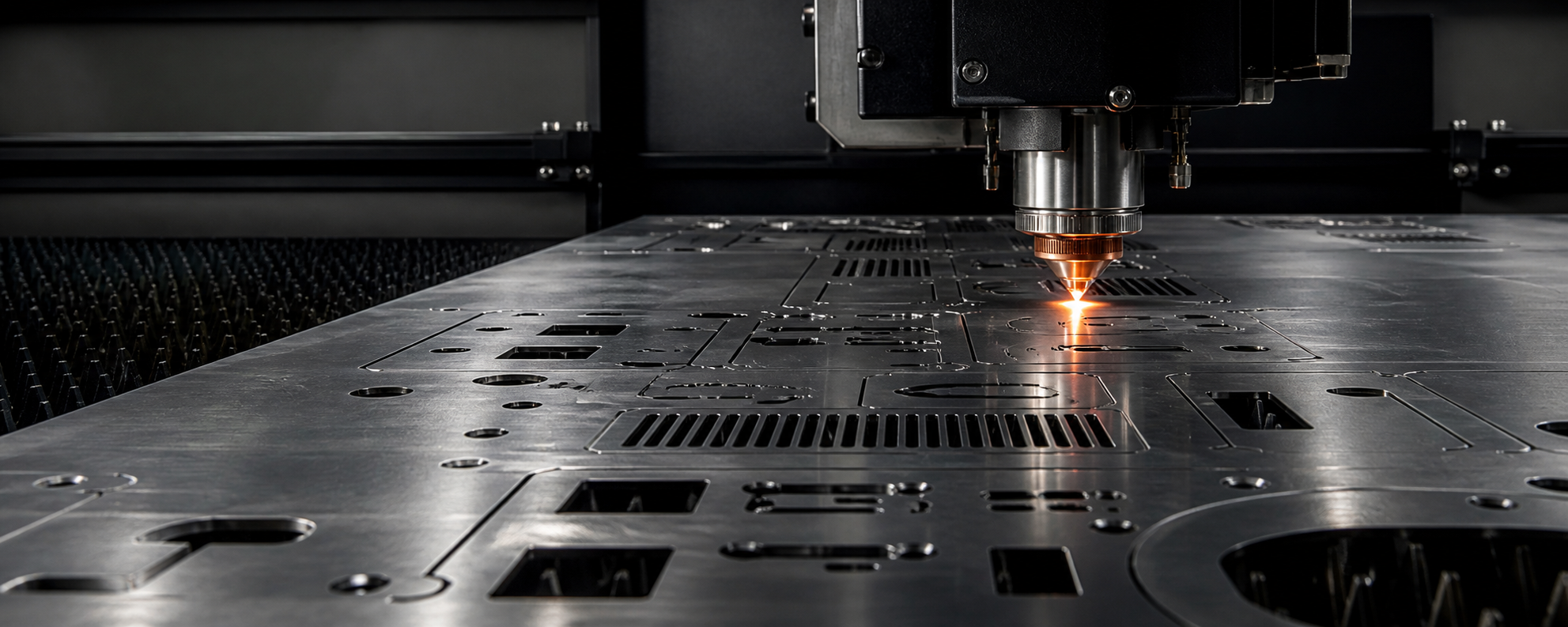
A focused beam follows programmed internal and external contours. Assist gas, material response and cut settings influence the edge.
A selected punch enters a matching die. The sheet is positioned repeatedly so each stroke creates a hole, cut or form.
Some suppliers use separate operations or punch-laser combination equipment when one part benefits from both technologies.
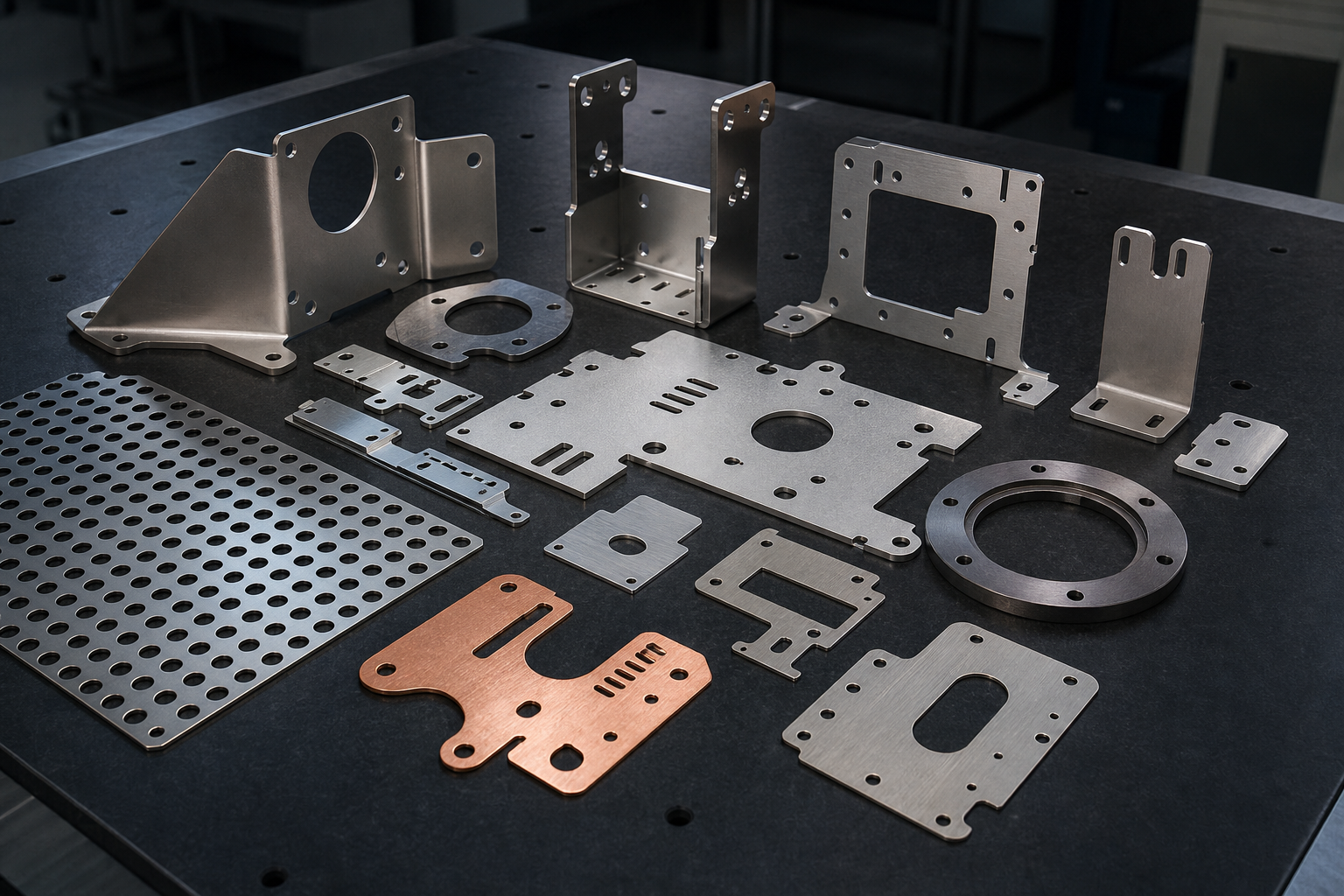
Laser cutting removes a narrow path of material. It can change direction freely within the supported process and is therefore suitable for profiles that would need many different physical punch shapes. A turret punch shears material between a punch and die. For a repeated hole matching an installed tool, one stroke can replace a complete laser contour.
Industry punch-laser systems illustrate the complementary relationship: the punch handles standard contours and forming while the laser handles complex contours. That does not mean every supplier owns a combination machine. The production route may instead use separate machines, and Lumen Future will review the submitted geometry against the available process.
Irregular Profiles, Standard Holes and Nibbling
Why laser cutting suits changing profiles
A laser follows digital geometry rather than the outline of a dedicated cutting tool. This makes it a strong option for prototypes, different part numbers nested on the same material and components that remain under engineering revision. New geometry still requires programming and DFM review, but it does not normally require a new physical tool for every contour.
This flexibility is especially useful for machine brackets, covers, guards and low-volume panels with irregular edges. The value is not simply cutting speed; it is the ability to move from approved geometry to production without waiting for a contour-specific hard tool.
Why punching suits repeated standard features
If a panel contains many holes matching an available punch, the turret can create each one with a stroke. Repeated circular, square or obround openings can therefore favour punching, particularly when the part and quantity keep the machine productive. Cluster or multi-tools may further change the calculation on suitable equipment.
The advantage depends on the exact tool being available and maintained. A non-standard size, special corner radius or unusual shape may require a purchased tool. Tool cost, delivery, setup, sharpening and replacement should then be included in the comparison.
What happens with curves and large cutouts?
A turret punch can create a larger or curved contour through a sequence of overlapping hits called nibbling. This expands the geometry it can process, but the edge may show witness marks and the hit count can increase machine time. A special tool, a shearing tool or a laser route may be preferred when the contour is visible, dimensionally critical or repeated often enough to justify another approach.
Formed Features Are the Turret Punch’s Strategic Advantage
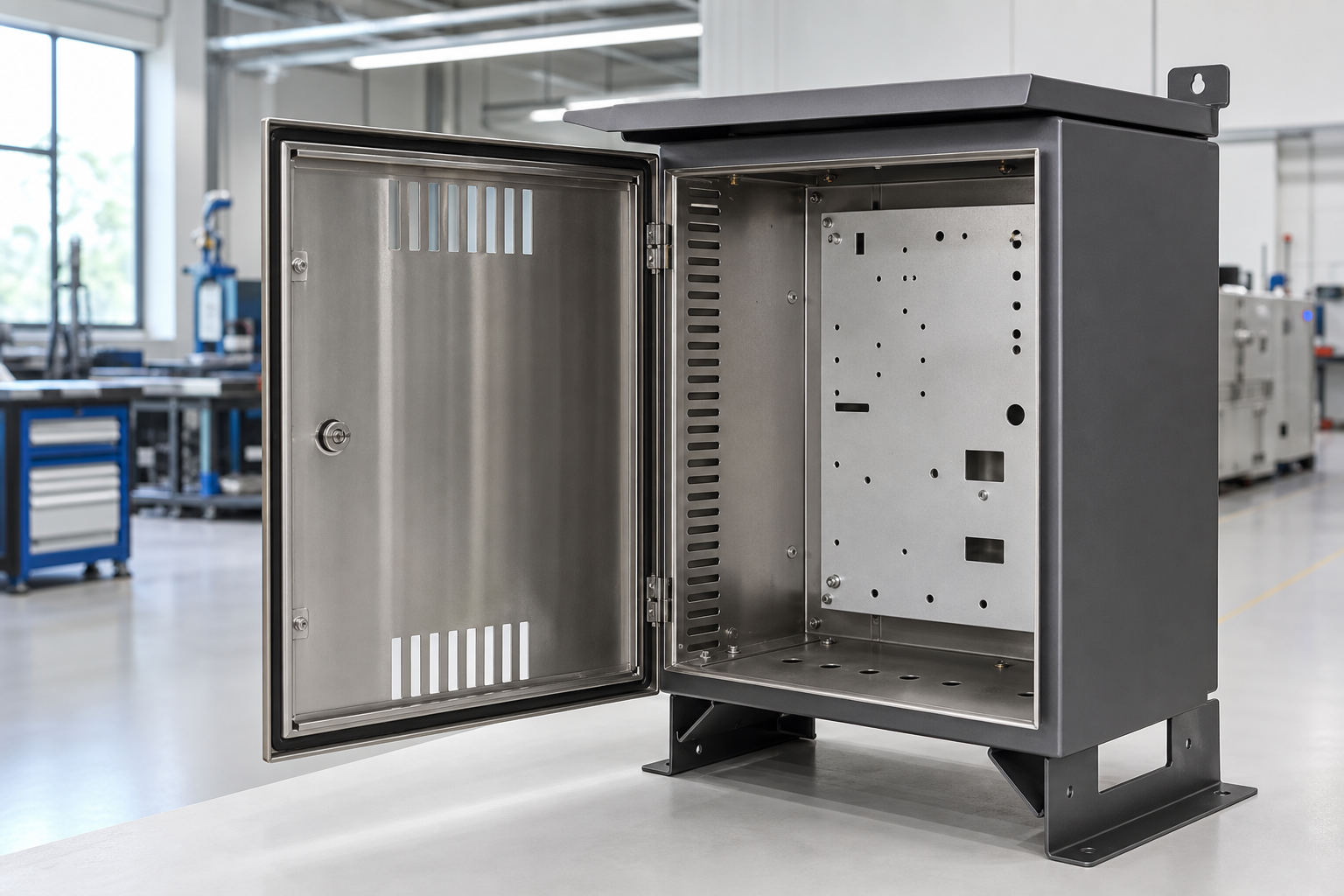
Laser cutting is a separation process. It can create the opening for a later operation, but it cannot by itself raise a louver, form an extrusion or emboss a local feature. Compatible turret tooling may integrate several operations into the flat-sheet cycle:
- ventilation louvers;
- electrical knockouts;
- embosses and identification marks;
- extruded or flanged holes;
- countersink-style forms within validated limits;
- stiffening beads and small offsets;
- tabs or local bends; and
- formed threads or tapping on suitably equipped machines.
This can reduce handling between machines and change total part cost even when laser cutting appears faster for the 2D outline. TRUMPF’s official tooling documentation, for example, shows punching tools for louvers, threads, bends, cups and other formed sheet features. These examples describe industry capability, not a promise that every feature is available on every supplier’s machine.
Tool access, forming height, sheet thickness, feature spacing, sheet movement and part flatness must be checked. A tall form created too early can interfere with the machine or scratch the sheet during subsequent movement. Process sequence matters.
Tolerance, Burrs and Surface Condition
Neither process should be assigned one universal finished-part tolerance. Machine positioning specifications are not the same as guaranteed part accuracy. The result also depends on part size, material grade and thickness, sheet flatness, heat distribution, tool condition, tool clearance, edge location, feature density, handling and the inspection method.
| Quality characteristic | Laser-cut result may depend on | Punched result may depend on |
|---|---|---|
| Hole size | Beam/process settings, pierce strategy, heat and nominal geometry. | Punch size, die clearance, tool wear, material springback and burr. |
| Hole position | Sheet position, thermal movement, part size and datum strategy. | Machine positioning, sheet movement, clamp zones and material stability. |
| Outside profile | Kerf compensation, cut sequence, heat and edge condition. | Tool geometry or nibble sequence, clearance and witness marks. |
| Edge finish | Striations, oxide, heat tint or dross may require review. | Rollover, sheared/fractured zones and burr direction are characteristic. |
| Flatness | Incoming sheet and concentrated heat can affect stability. | Incoming sheet, punching force and dense feature patterns can affect flatness. |
| Visible surface | Slats, spatter, handling and secondary operations need control. | Sheet travel, tool contact and debris can create rub or impression marks. |
For dowel holes, bearing seats, close-fit assembly holes and other precision features, consider whether drilling, reaming or CNC machining is required after profiling. State the datum, tolerance, inspection method and functional fit on the controlled drawing. See our guide to laser cutting tolerances buyers should specify.
Cosmetic components should identify the visible face, grain or brush direction, protective film requirement and acceptable handling marks. Punching is not automatically too rough for cosmetic work, and laser cutting is not automatically scratch-free. The production and handling plan controls the outcome.
How Volume, Tooling and Secondary Work Affect Cost
A useful quotation comparison separates setup from variable processing and downstream work.
Laser cutting often avoids a contour-specific tool investment, which helps prototypes and evolving designs. Its cost can rise with long cutting distance, many pierces, thicker material, demanding gas or edge requirements and slow unloading of dense nests.
Turret punching can become attractive when an available tool creates repeated features quickly or when forming operations replace separate equipment. Its cost can rise with special tools, frequent tool changes, high hit counts, nibbling, maintenance and secondary finishing.
Why part quantity is not enough
- Low quantity, complex geometry: laser frequently has the simpler starting route.
- Stable quantity, repeated standard holes: punching may reduce processing time if tools are available.
- Stable quantity, special repeated shape: compare special-tool amortisation with laser cutting time.
- Formed panel: account for operations eliminated by turret forming, not only the flat profile.
- Mixed product family: laser flexibility may reduce changeover and tooling complexity.
Material utilization also affects both routes. Part rotation, grain direction, surface requirements, clamp zones, nesting rules and skeleton stability influence how much sheet is assigned to each part. For this separate cost lever, see our sheet metal nesting and material yield guide.
When Should You Choose Each Process?
Laser cutting is usually worth evaluating when:
- the perimeter or internal contours are irregular;
- several different part numbers share the same material;
- the order is a prototype or changing low-volume build;
- engineering revisions are likely;
- special punch tooling would not be economical;
- nibble marks would be undesirable on visible curves; or
- the part does not need in-machine forming features.
Turret punching may be the better route when:
- the design contains many repeated standard holes;
- the correct maintained tools are already available;
- louvers, knockouts, embosses or extrusions can be integrated;
- the design and quantity are stable enough to use a special tool economically;
- the punched edge and burr direction meet the drawing requirements; or
- one punching setup can remove multiple downstream operations.
Consider a combined or staged route when:
A component has a complex laser-cut perimeter but also needs formed features. Depending on supplier capability, it may be processed on separate machines or punch-laser equipment. Do not prescribe a combination machine unless it is functionally necessary; describe the required part and let the fabricator propose a controlled route.
Three Illustrative Selection Scenarios
The bracket has an irregular outside profile, several different slots and a small first batch. It has no formed features. Laser cutting is a logical first process to evaluate because geometry changes are handled digitally and a special punch tool may not be recoverable across the quantity.
The panel contains a large array of repeated standard openings plus formed louvers. If suitable tools and machine capacity are available, turret punching may combine fast repeated hits with forming and reduce downstream work.
The part combines a free-form perimeter, repeated holes, a knockout and a visible brushed face. Compare laser, punching and a staged route while controlling grain direction, surface contact, edge requirements and handling. The lowest machine rate is not necessarily the lowest accepted-part cost.
These examples illustrate decision logic only. They are not fixed process rules, Lumen Future quotations or claims about a particular machine configuration.
Design and File Preparation
Submit nominal finished geometry rather than adding laser kerf or punch clearance to the customer model. The manufacturing supplier should apply process-specific compensation after reviewing the material and equipment. Use:
- DXF for clean 2D cutting geometry;
- STEP for formed features, assemblies and three-dimensional design intent; and
- PDF for controlled dimensions, tolerances, datums, visible faces, finish and inspection notes.
Review holes, slots, tabs, edge distances and bend relationships using our sheet metal laser cutting design guide. If files disagree, state which controlled document governs. Do not leave the supplier to infer whether a louver shown in STEP is a required production feature or merely simplified CAD geometry.
RFQ Checklist
This information lets a supplier compare the complete laser, punching or staged manufacturing route. Singapore buyers should also identify local delivery, engineering-revision and inspection coordination requirements, without assuming that a local route is automatically cheaper for every volume. For a broader cost breakdown, read our laser cutting cost guide for Singapore buyers and laser cutting quotation guide.
Frequently Asked Questions
Is turret punching the same as metal stamping?
No. A CNC turret punch selects interchangeable tools to create features one operation or hit sequence at a time. Production stamping usually relies on dedicated dies designed for a specific component or operation and follows a different tooling and volume model.
Is laser cutting cheaper than turret punching?
Not universally. Laser cutting often avoids special-tool cost for changing or complex profiles. Turret punching may be more economical for many repeated standard holes or when forming tools eliminate secondary operations. Compare the complete finished-part route.
When is turret punching faster than laser cutting?
It can be faster when suitable installed tools create many repeated features with relatively few strokes and tool changes. The result depends on hole count, tool inventory, sheet movement, machine automation and whether nibbling or special tools are required.
Can a turret punch create formed sheet metal features?
Yes, suitably equipped machines and tools can create features such as louvers, knockouts, embosses, extrusions and selected bends or threads. Feature height, spacing, material and machine clearance must be reviewed.
Which process produces less burr?
Neither process is automatically burr-free. Laser edges can show dross or heat-related effects, while punched edges can show rollover, fracture and burr. Material, settings, tooling condition, clearance and the required finishing process determine the delivered edge.
Can laser cutting and punching be used on the same part?
Yes. Some parts benefit from laser-cut complex contours and punched or formed standard features. The operations may be performed on separate equipment or a punch-laser system, depending on supplier capability and the drawing.
Request a Sheet Metal Process Review
Lumen Future provides sheet metal laser cutting services in Singapore. Send the material, thickness, quantity and controlled drawings. We can review whether laser cutting fits the geometry and identify features that may require forming, machining or another process.
Technical references: TRUMPF, Punching and Nibbling; TRUMPF, Punching Tools for Forming. These references explain general industry process capabilities; the manufacturable route for a Lumen Future project depends on the submitted drawing and available production equipment.