None is universally stronger, stiffer or cheaper. The final choice depends on material grade, actual section dimensions, wall thickness, member length, loading direction, connections, availability and the applicable engineering standard.
Selecting a tube profile affects far more than appearance. It changes how a frame carries load, how brackets attach, how holes are referenced, how weldments are located and which stock sizes can be sourced. A profile that looks efficient in a CAD model may create difficult connections or a longer procurement lead time.
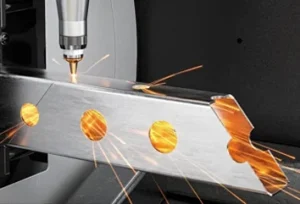
This guide compares round vs square tube and rectangular tube for fabricated frames, machine guards, supports and welded assemblies. It is written for engineering and procurement teams sourcing custom tube parts in Singapore. For a manufacturing review, see our metal tube and profile laser cutting service.
What Are CHS, SHS and RHS?
HSS—Hollow Structural Section—is a common North American umbrella term covering circular, square and rectangular structural hollow sections. A round HSS is not automatically interchangeable with pipe specified for fluid service. Dimensions, grades, tolerances and naming systems may differ.
Do not request only “50 mm tube” or “two-inch pipe.” A useful specification includes the section type, outside dimension, nominal wall thickness, material grade and product standard. State whether a substitute section is permitted.
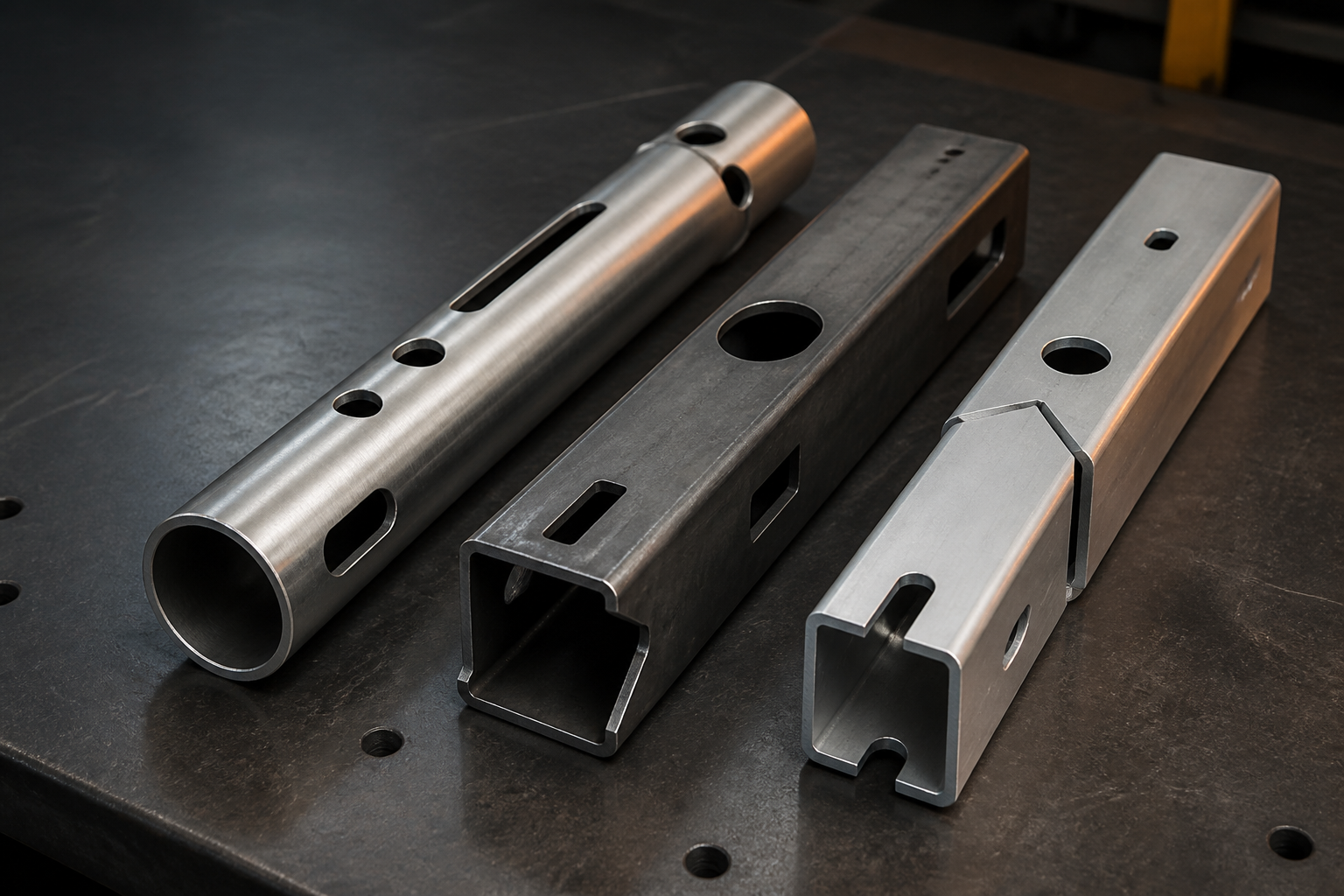
Round vs Square vs Rectangular Tube: Quick Selection Matrix
| Selection factor | CHS / Round | SHS / Square | RHS / Rectangular |
|---|---|---|---|
| Flat mounting face | Usually needs a saddle, shaped bracket or limited contact area | Four flat faces simplify mounting | Wide face can suit panels and base plates |
| Orientation | Exterior shape is rotationally continuous; clocking still matters for holes and seams | Equal nominal width and height, but individual faces may still be specified | Width × height direction must be controlled |
| Multi-face features | Require axial and angular references | Faces are easy to identify | Faces are easy to identify, but long and short sides are not interchangeable |
| Frame jigging | May need cradles or anti-rotation stops | Flat faces suit common fixture stops | Wide face can provide stable location |
| Panel attachment | Often needs additional brackets | Usually direct and modular | Wide face offers useful mounting area |
| Visual style | Smooth, tubular and suitable for exposed or hand-contact elements | Regular, industrial and modular | Directional, low-profile or wide-base appearance |
| Best starting point | Handrails, exposed frames and designs without a preferred external face | General machine frames, guards and bracket-rich structures | Directional beams, bases and space-constrained frames |
This table is a DFM starting point. It is not a strength ranking. Compare actual section properties and connection requirements before approving a profile.
Stiffness, Directionality and Torsional Loading
Round tube: geometry without a preferred external face
A circular section has the same external geometry after rotation about its longitudinal axis. This can be useful where appearance, smooth contact surfaces or loading around the axis matters. It does not remove the need to define angular orientation for holes, slots, brackets or the longitudinal weld seam.
Round tube should not automatically be labelled “stronger.” Its performance depends on diameter, wall thickness, grade, member length, loads and connections. For a fair comparison, use the actual section properties rather than comparing only outside width.
Square tube: similar geometry about two principal directions
SHS provides equal nominal outside width and height, making it a natural starting point for modular frames and structures with similar packaging in two directions. Flat faces simplify interfaces, but the formed corners are radiused and local wall behaviour at brackets or concentrated loads still requires engineering review.
Rectangular tube: orientation is part of the design
RHS has different section depth in its two principal directions. The deeper orientation may be useful where bending and packaging are strongly directional, while the wider face can help support plates or panels. Turning the same section by 90 degrees changes both structural orientation and interface layout.
For RHS, the drawing, STEP model and cutting program must agree on which dimension is width and which is height. A 100 × 50 profile is not functionally equivalent to the same member installed as 50 × 100.
Do not reduce torsion to a slogan
Closed hollow sections generally offer efficient torsional behaviour compared with many open sections. However, “round is always best in torsion” is not a sufficient selection rule. Compare the torsional properties of the actual available CHS, SHS and RHS sizes, then check member length, connections, openings and combined loads.
Attaching Plates, Brackets and Panels
Connections to CHS
A flat plate touches a round tube along a limited region unless the plate, saddle or tube end is shaped. Common solutions include contoured brackets, fish-mouth cuts, sleeves, tangent plates and welded bosses. The connection’s local stresses and weld design must be checked for the actual load.
Round-to-round joints can look clean but may require more complex cutting and rotational control. Mounting several brackets at defined angles also requires a reliable clocking datum.
Connections to SHS
Four flat faces simplify the positioning of plates, hinges, feet, castors, sensor brackets and guarding panels. Parts can often be located against straight fixture stops. This is a fabrication advantage—not proof that the connection is structurally adequate. Thin HSS walls may still require reinforcement, through-bolts, sleeves or another engineered detail.
Connections to RHS
The wide face provides useful space for mounting plates, rails and equipment. The increased face width can also make local wall behaviour more important under concentrated loads. The structural engineer should evaluate whether a backing plate, internal sleeve, diaphragm or revised connection is needed.
| Connection need | Profile often evaluated first | Why |
|---|---|---|
| Flat equipment bracket | SHS or RHS | Direct planar interface |
| Handrail or grip surface | CHS | Smooth continuous exterior |
| Wide base plate | RHS | Broad mounting face |
| Symmetrical modular frame | SHS | Equal nominal width and height |
| Round branch connection | CHS with shaped joint | Continuous tubular appearance |
Laser Cutting Holes, Slots and Multi-Face Features
All three profile families can carry laser-cut holes, slots, notches and end contours when the material, size and machine configuration permit. The main design difference is how the feature is referenced.
- CHS: define axial position plus angular clocking around the tube axis.
- SHS: identify the functional face and avoid treating the formed corner as a sharp CAD line.
- RHS: define the long and short faces and prevent 90-degree orientation errors.
Round holes on CHS intersect a curved surface; holes on SHS and RHS are easier to represent on flat faces but may be affected by corner radius, twist and face relationships. Features close to an end, corner or weld seam require additional DFM review.
For feature design rules, use our tube laser cutting design guide for holes, slots and joints. For datum and inspection planning, read Tube Laser Cutting Tolerances.
Welding, Jigging and Assembly
| Fabrication factor | CHS | SHS | RHS |
|---|---|---|---|
| Fixture location | Cradles or anti-rotation features may be needed | Flat faces suit stops and squares | Wide face offers stable location; orientation must be controlled |
| Tube-to-tube joint | Often needs fish-mouth or saddle geometry | Straight and mitre joints are visually simple | Joint changes with the selected orientation |
| Bracket alignment | Angular clocking is important | Face reference is straightforward | Long-face/short-face reference is essential |
| Weld access | Varies around curved joints | Usually clear on external corners and faces | Check access around wide plates and shallow sides |
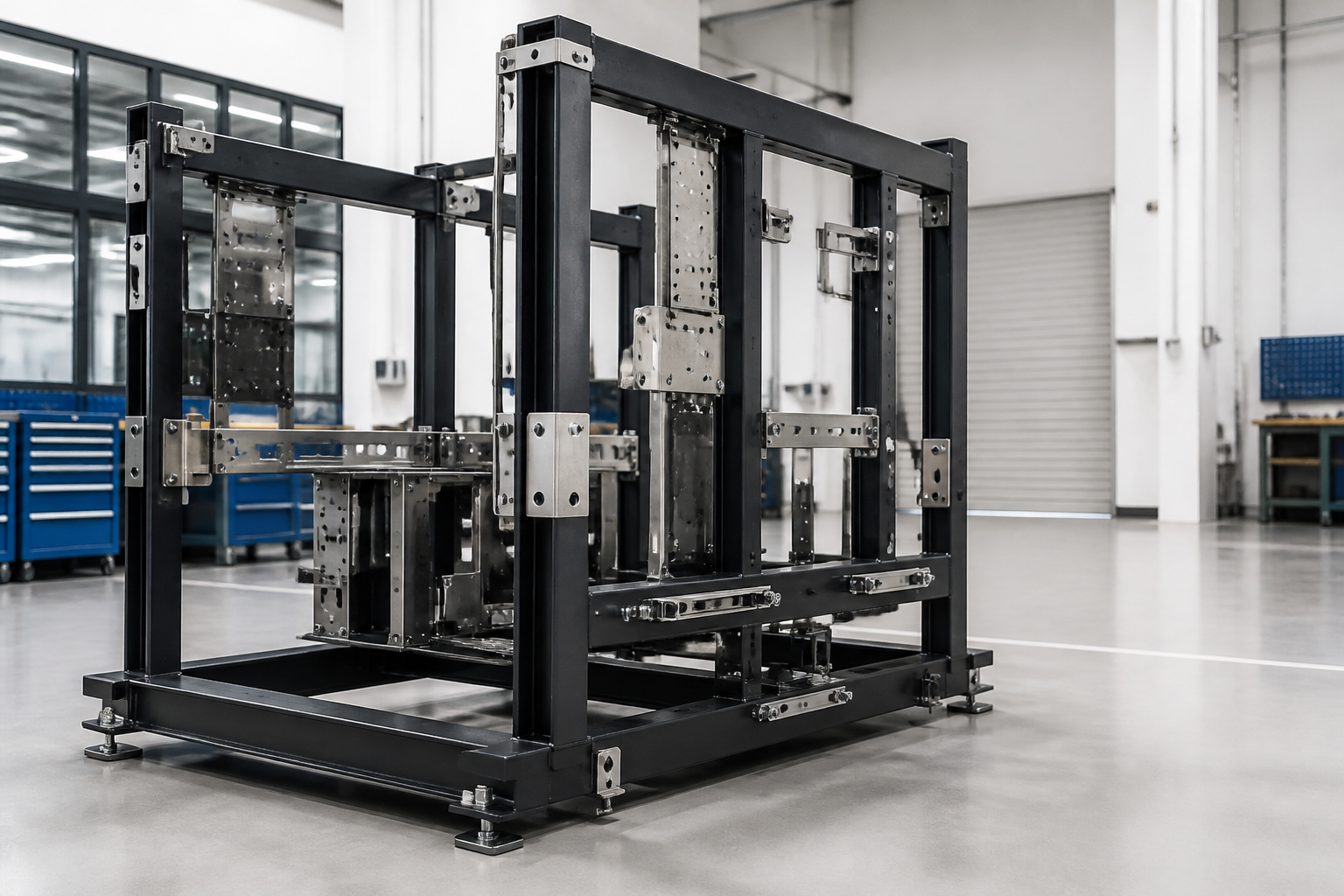
Self-locating notches, tabs and slots can help control orientation before welding, but they do not automatically eliminate fixtures or distortion. The welding sequence, joint design and post-weld critical dimensions still need review. Coordinate tube cutting with the intended welding and structural assembly process.
Surface Finishing, Cleaning and Enclosed Cavities
Finishing requirements should be considered before the profile is selected and the frame is sealed:
- CHS has no external flat-face corners, but curved surfaces require suitable fixturing and spray coverage.
- SHS and RHS provide broad surfaces for polishing, coating and protective film, while formed corners and weld transitions need attention.
- Internal hollow surfaces are harder to inspect, clean and coat consistently than accessible external faces.
- Closed assemblies may need appropriately designed vent and drain openings for the selected finishing process.
- Grinding welds flush can change appearance and local geometry; specify cosmetic faces in advance.
Discuss finish-sensitive areas with the supplier before cutting. Relevant downstream capabilities may include polishing and grinding or laser cleaning, depending on the material and process requirement.
Material Availability, Standards and Procurement
A theoretically efficient profile can create unnecessary cost or delay if the exact grade, size or wall thickness is not readily sourced. Check availability before freezing the frame design, particularly for unusual RHS proportions, special alloys or thin-wall profiles.
A complete section specification should include:
- CHS, SHS, RHS or special profile.
- Outside diameter or width × height.
- Nominal wall thickness.
- Material grade and product standard.
- Welded or seamless requirement, if functionally relevant.
- Surface condition and finish.
- Weld-seam orientation requirement.
- Stock length, finished lengths and quantities.
- Material certificate requirement.
- Whether an alternative section can be proposed.
Do not substitute one profile solely because its outside dimensions look similar. Section properties, mass, corner radii, material specification and connection design may change.
Which Profile Fits Common Fabricated Frames?
Automation machine frames
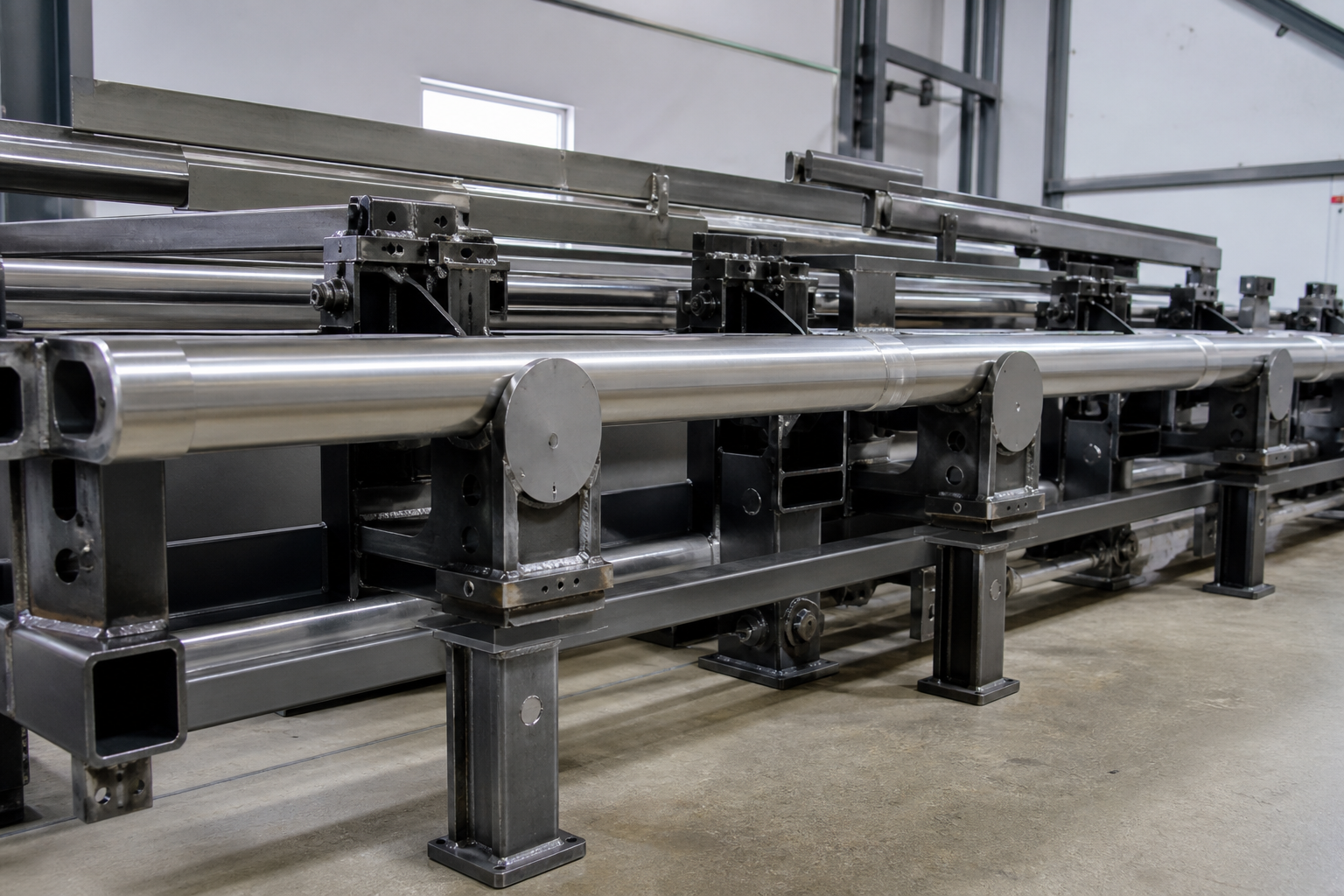
SHS is often evaluated first for modular frames because flat faces simplify panels, sensor brackets, feet and guarding. RHS may suit a base or cross-member where section depth is needed in one direction. CHS can be useful for exposed tubular members or rotating/handling structures. Final vibration, stiffness and load requirements remain an engineering decision. See our industrial automation fabrication applications.
Machine guards, barriers and hand-contact elements
SHS and RHS simplify mesh, hinge and panel attachment. CHS offers a smooth grip or rail surface. A mixed-profile frame may be more practical than forcing one section type into every member.
Marine and offshore assemblies
Profile choice should account for drainage, sealed cavities, material grade, coating access, weld quality and service exposure. Round geometry alone does not guarantee better corrosion performance. Refer to the project specification and qualified engineering review. Explore our marine and offshore application support.
Furniture and display frames
CHS creates a smooth visual language and hand-contact surface. SHS produces a regular industrial or architectural appearance. RHS can create low-profile rails, wide support faces and visually directional members.
Construction and structural supports
CHS, SHS and RHS are all used in structural work, but member and connection design must follow the applicable project code. Lumen Future can review fabrication inputs; structural adequacy and regulatory compliance remain with the project engineer. See our construction and infrastructure applications.
Final Profile Selection Matrix
| Project priority | First profile to evaluate | Reason |
|---|---|---|
| Flat brackets and panels | SHS or RHS | Planar mounting interface |
| No preferred external face | CHS | Continuous round exterior |
| Directional depth within a tight envelope | RHS | Different width and height |
| Simple rectangular welded frame | SHS | Fixture and face alignment are direct |
| Handrail or smooth exposed member | CHS | Comfortable continuous surface |
| Wide equipment base | RHS | Broad mounting face |
| Mixed torsion and bending | Engineering comparison required | Use actual section properties and connections |
| Safety-critical load-bearing frame | Engineer-selected | Requires code-based design and verification |
What to Include in a Tube-Frame RFQ
- STEP model of the parts and complete frame where available.
- Controlled PDF drawings with revision, datums and critical dimensions.
- CHS, SHS or RHS dimensions and wall thickness.
- Material grade, standard and certificate requirement.
- Prototype and expected production quantities.
- Hole, slot, notch, mitre and weld-preparation details.
- Weld type, cosmetic-face and post-weld requirements.
- Grinding, cleaning, coating or finishing requirements.
- Inspection and dimensional-report requirements.
- Required delivery location and schedule in Singapore.
Frequently Asked Questions
Is round tube stronger than square tube?
Neither is universally stronger. Strength and stiffness depend on material grade, actual dimensions, wall thickness, member length, loading direction, connections and the applicable design rules. Compare the specific available sections.
Is square or rectangular tube better for a welded frame?
Square tube often simplifies symmetrical frames and flat attachments. Rectangular tube can provide useful depth in one direction or a wider mounting face. The better choice depends on loads, packaging, connections and availability.
Which tube is better for torsional loading?
CHS, SHS and RHS are all closed sections, but their torsional properties differ by actual geometry and wall thickness. Do not select by shape name alone; compare section data, member length, openings and connection behaviour.
Is round tube harder to laser cut than square tube?
Both can be laser cut with suitable equipment. Round tube requires angular clocking for positioned features, while square and rectangular tube require face identification and control of corners, twist and orientation.
Which profile is easier for brackets and panels?
SHS and RHS generally provide flat mounting faces that simplify brackets and panels. CHS can still accept brackets but may need shaped plates, saddles or purpose-designed interfaces.
What information is required for a tube-frame quotation?
Provide the STEP model, PDF drawing, section type and dimensions, material grade, wall thickness, quantities, cutting features, welding, finishing, inspection and delivery requirements.
Sources and Technical Context
- AISC: HSS definitions, specification and design resources
- AISC: round, square and rectangular ASTM A1085 HSS data
- AISC Design Guide 24: HSS connection design context
- Steel Tube Institute: HSS dimensions and section properties
Review a Tube Profile Before Quotation
Send the frame model, drawings, profile specification, material and quantities. Lumen Future can review cutting, joint geometry, welding, finishing and inspection requirements before quotation.