Both cast and extruded acrylic can be laser cut, but they are not interchangeable. Cast acrylic is usually the stronger starting choice for detailed engraving and a frosted, high-contrast mark. Extruded acrylic normally offers more consistent sheet thickness and may produce a smoother flame-polished cut edge with efficient cutting. Final selection should still be verified against the actual product grade, thickness, colour, fit requirement and approved sample.
Ordering “clear acrylic, 3 mm” does not fully define the material. The same nominal description may refer to cast or extruded sheet, different brands, different thickness tolerances and different surface or optical grades. Those differences can change the cut edge, engraving contrast, slot fit, bonding behaviour and repeatability of a production batch.
This guide explains how cast and extruded acrylic respond to laser cutting and engraving, what buyers should measure before designing press-fit features, and when a sample is more reliable than a generic material rule. For the wider process and edge discussion, see our acrylic laser cutting guide for Singapore.
Start by evaluating cast acrylic
- Frosted, high-contrast laser engraving
- Awards, signs and detailed graphics
- Premium visual applications
- Special colours, blocks or optical grades
- Projects where actual sheet thickness can be measured and accommodated
Start by evaluating extruded acrylic
- Cut-only parts and production profiles
- More consistent sheet thickness
- Slot, tab and stacked-sheet designs
- Cost-sensitive repeat production
- Projects seeking an efficient, glossy laser-cut edge
Cast vs Extruded Acrylic: Key Differences
| Selection factor | Cast acrylic | Extruded acrylic |
|---|---|---|
| Manufacturing route | Liquid material is cast and cured between mould surfaces | Molten PMMA is continuously extruded, calibrated and rolled |
| Sheet thickness | Can show greater variation within a sheet and between batches | Normally offers more consistent calibrated thickness |
| Laser-cut edge | Can produce a clean, burr-free edge; gloss and clarity vary by grade and settings | Often produces a smooth, flame-polished appearance with suitable settings |
| Laser engraving | Usually creates a strong white or frosted contrast | Usually creates a lighter, clearer or greyer result |
| Cutting parameters | May require different energy and speed from extruded sheet of the same nominal thickness | Some grades process efficiently at lower energy, but settings remain product-specific |
| Press-fit design | Actual thickness variation needs careful measurement and allowance | Thickness consistency is often advantageous for tabs and slots |
| Material cost | Often higher, depending on grade, colour and thickness | Often lower for standard production sheet |
| Typical starting use | Engraved signage, awards, branded displays and detailed graphics | Cut profiles, repeat parts, insert-fit assemblies and cost-controlled production |
How the Manufacturing Route Changes the Sheet
Cast acrylic is made by filling a mould, commonly formed between glass plates, and curing the material into a sheet. The mould surfaces can support high visual surface quality and a wide range of colours, textures and specialised products. Because each sheet is formed in a mould rather than calibrated continuously through a fixed roll gap, actual thickness may vary more than the nominal label suggests.
Extruded acrylic starts from PMMA material that is melted, pushed through a die and calibrated through a continuous production line. The controlled roll gap usually supports more consistent thickness and efficient volume production. The extrusion history can also give the sheet different processing behaviour from cast material.
Both remain PMMA. The words “cast” and “extruded” do not by themselves define colour, UV performance, optical transmission, coating, chemical resistance or fitness for a particular assembly. Those properties should come from the product code and datasheet.
Which Acrylic Gives the Better Laser-Cut Edge?
Extruded acrylic often produces the glossy, smooth, flame-polished appearance buyers associate with CO2 laser cutting. It may require less energy than cast sheet of the same nominal thickness, depending on the product. This makes extruded sheet a practical starting point for cut-only profiles and production work where engraving contrast is not the priority.
Cast acrylic can also cut with a clean, burr-free edge, but it does not necessarily produce the identical edge appearance. Some grades show a clear edge, while others look slightly different from extruded material. Higher variation in actual thickness can also influence focus, cut-through consistency and top-to-bottom edge appearance.
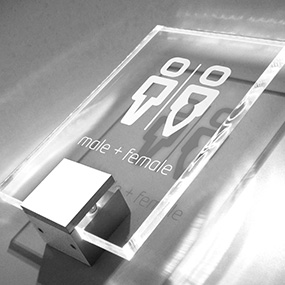
Do not evaluate only whether the edge looks transparent in one photograph. Inspect:
- top and bottom edge clarity;
- edge taper and dimensional difference through the thickness;
- rounding or melt-back at corners;
- striations, bubbles or vapour deposits;
- yellowing or colour change;
- local cracks, crazing or stress marks;
- repeatability from the first part to the last.
Edge quality still depends on thickness, focus, power, speed, extraction, air flow, path strategy and material condition. A label saying “laser grade” is useful only when it identifies a controlled product and is supported by a suitable production sample.
Which Acrylic Is Better for Laser Engraving?
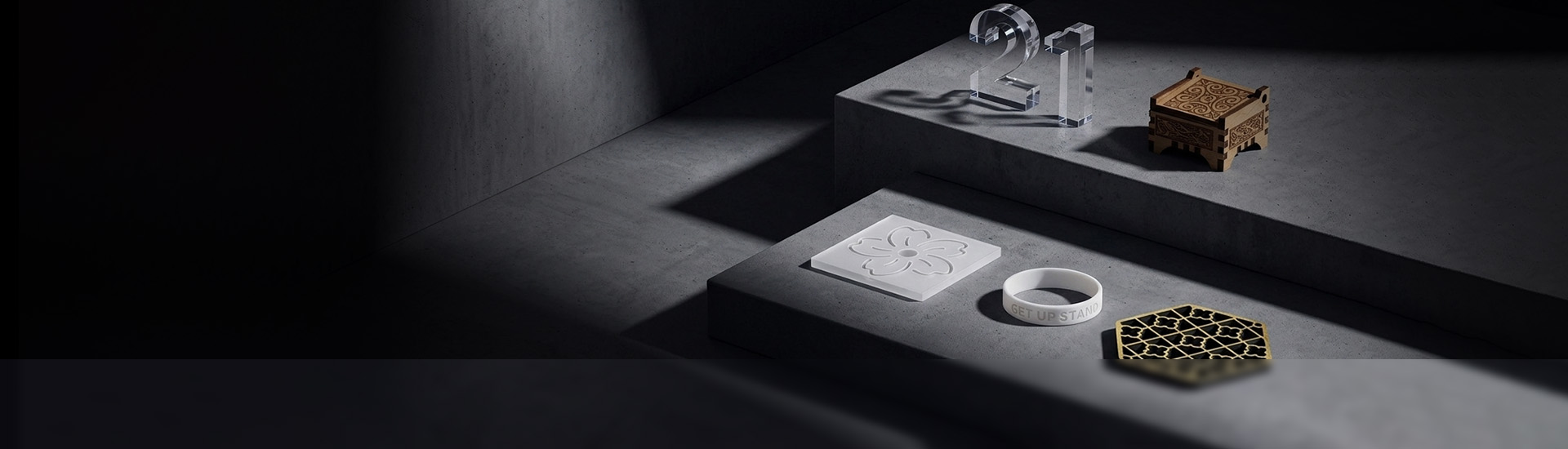
Cast acrylic is generally the stronger starting material for decorative laser engraving. The engraved surface normally becomes visibly frosted or white, providing contrast on clear or coloured sheet. That behaviour supports logos, text, photographs, awards, equipment labels and branded display components.

Extruded acrylic can be engraved, but the mark commonly appears clearer, greyer or less frosted than the equivalent cast material. That does not make it unusable. A subtle mark may be acceptable for an internal identifier, and filled colour or backlighting may change the visual requirement. The buyer should approve the actual combination of material colour, engraving depth, lighting and viewing distance.
Our guide to laser engraving on metal and non-metal materials explains why acrylic engraving should be specified by the desired surface effect rather than by machine type alone.
Thickness Consistency and Part Fit
A nominal thickness is a commercial material description, not a guaranteed exact measurement. This matters when the design contains slots, tabs, stacked layers, grooves, covers captured in a frame or any feature that depends on the sheet thickness.
Extruded sheet generally provides tighter thickness consistency because it is calibrated during continuous production. Cast sheet can have a wider thickness range, although the actual tolerance is manufacturer- and product-specific. Some manufacturers publish numerical examples, but those figures should not be copied as a universal standard for every acrylic supplier.
Cast vs Extruded for Slots and Press-Fit Designs
Extruded acrylic is often a practical starting point for production assemblies because its sheet thickness is typically more consistent. Cast acrylic may still be selected when engraving or visual properties are more important, but the design should accommodate the measured thickness range rather than assume an exact nominal value.
| Design situation | Recommended approach | Reason |
|---|---|---|
| One display prototype | Test either material | Visual result and immediate fit may matter more than batch variation |
| Repeat tab-and-slot assembly | Start by evaluating extruded sheet | Thickness consistency can simplify repeat fit |
| Engraved interlocking sign | Balance cast engraving against actual thickness variation | The best visual engraving and the easiest fit may not come from the same material |
| Tight slot or snap fit | Use a test comb cut from production material | CAD nominal values do not capture the complete process |
| Bonded enclosure | Test the complete material, edge and adhesive system | Clarity alone does not prove bonding suitability |
| Multiple stacked layers | Measure total stack accumulation | Small layer differences accumulate through the assembly |
A practical fit test
- Record the material brand, grade, colour, batch and stated manufacturing route.
- Measure actual thickness at several sheet locations.
- Create a test comb with a controlled series of slot widths or clearances.
- Cut the test using the intended production parameters and orientation.
- Allow the material to cool and test it with the real mating part.
- Record the accepted geometry and use it only for the controlled material and process.
Heat, Residual Stress and Crazing
Fine cracks that appear around cut edges, fasteners or bonded joints are often described as crazing. It is not responsible to state that one acrylic type always crazes and the other never does. Manufacturing stress, sheet quality, laser heat, sharp corners, external load, cleaning chemicals, adhesives and service temperature can all contribute.
Cast material is often described as having a wider processing window, while extruded material can require closer control in some machining or thermal operations. That general tendency does not replace a product datasheet or sample. Laser settings developed for one brand, colour and thickness should not automatically be transferred to another.
Tell the supplier if the finished part will be solvent bonded, thermoformed, cleaned with chemicals, clamped by screws or held under continuous stress. A visually good cut edge may still need annealing, edge preparation, corner radii or a different joining design for its downstream use.
Colour, Mirror, Frosted and Specialty Acrylic
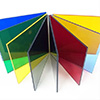
Cast versus extruded is only the first material decision. Acrylic may also be clear, translucent, opaque, coloured, fluorescent, mirrored, frosted, light-diffusing, UV-transmitting, antistatic or coated. Additives and backing layers can change absorption, engraving contrast, edge appearance and fume behaviour.
- Mirrored acrylic: identify the reflective backing and the protected face before cutting.
- Light-diffusing sheet: select from optical and lighting performance, not edge clarity alone.
- Frosted or textured sheet: confirm which face is cosmetic and how masking should be handled.
- Coloured sheet: approve contrast and edge colour using the real grade.
- Coated sheet: confirm whether the coating is compatible with laser processing and downstream cleaning.
Do not approve a clear-sheet sample for a later production order in a different colour or mirror construction without confirming that the material family and laser response are equivalent.
Cost and Availability in Singapore
Extruded acrylic is often less expensive for standard sheet and repeat cutting, while cast acrylic commonly carries a higher material price. But material price alone is not the finished-part cost. High-contrast engraving on cast acrylic may avoid printing or colour filling, while an unsuitable low-cost sheet can create extra testing, poor fit, rework or replacement.
Material + sheet utilisation + file and sample setup + cutting + engraving + fit validation + finishing + inspection + packing and deliveryAvailability of the specified brand, colour, thickness and minimum purchase quantity can affect a Singapore quotation and lead time.
For repeat orders, specify whether material substitution is allowed. If optical appearance, thickness or assembly fit depends on a controlled grade, include the manufacturer and product code on the drawing or purchase requirement. Our laser cutting cost guide explains how material and setup interact with quantity and downstream work.
Application Decision Matrix
| Application | Starting material choice | What to validate |
|---|---|---|
| Engraved award or commemorative plaque | Cast | Frosted contrast, colour, depth and edge appearance |
| Clear display outline | Extruded or a validated laser-grade cast product | Top and bottom edge clarity, taper and optical sample |
| Repeat tab-and-slot display | Extruded | Actual thickness, kerf, slot clearance and batch repeatability |
| Sign with engraved text | Cast | Readability, lighting, viewing distance and colour contrast |
| Transparent machine guard | Application-specific grade | Load, holes, chemicals, service environment and edge stress |
| Light diffuser or guide | Specified optical grade | Transmission, diffusion, engraving pattern and lighting test |
| Laser plus CNC engineering part | Test against the complete route | Workholding, machined features, edge finishing and final inspection |
If the part also contains pockets, counterbores or controlled machined features, use our guide to laser cutting versus CNC routing for acrylic to select the process as well as the sheet type.
How to Validate an Acrylic Grade Before Production
Choosing Cast or Extruded Acrylic in Singapore
Singapore projects use acrylic for retail displays, automation guards, equipment covers, electronics fixtures, architectural models, awards and illuminated signs. Local stock can vary by colour, thickness, surface and brand. Ask whether the quoted material is the specified product, an equivalent or a supplier-selected substitute.
For prototypes, a locally available equivalent may be acceptable if visual and fit requirements are tested. For repeat production, controlling the material code can reduce unexpected changes in thickness, engraving contrast or edge appearance. Our non-metal cutting service covers project review for acrylic and other polymer sheet materials.
Cast vs extruded acrylic RFQ checklist
- Cast or extruded requirement
- Manufacturer and product code
- Colour and transparency
- Surface texture or coating
- Nominal thickness
- Acceptable actual thickness range
- Customer- or supplier-provided sheet
- Permission for material substitution
- Cutting, engraving or both
- Required edge appearance
- Critical slots and mating parts
- Bonding or thermoforming after cutting
- Cleaning chemicals or service environment
- Quantity and repeat forecast
- Approved sample requirement
- Inspection and fit testing
- Scratch-protective packing
- Singapore delivery date and location
Send a DXF for cutting paths and a dimensioned PDF or STEP model where fit and assembly matter. The CAD file preparation guide explains how to identify material, layers, critical dimensions and revision requirements.
Frequently Asked Questions
Is cast or extruded acrylic better for laser cutting?
Both can be laser cut. Extruded acrylic often provides consistent thickness and a smooth flame-polished edge, while cast acrylic is commonly chosen when detailed engraving or specialised visual grades matter. Test the actual product for critical work.
Which acrylic gives the clearest laser-cut edge?
Extruded acrylic often produces a glossy edge under suitable CO2 laser conditions, but the result depends on product grade, thickness, colour and settings. Some cast products also cut with very clear edges, so approve a real sample.
Which acrylic is better for laser engraving?
Cast acrylic normally produces a more visible frosted-white engraving. Extruded acrylic can be engraved, but the result is commonly clearer, greyer or lower in contrast.
Is cast acrylic always more expensive?
Cast sheet is often more expensive than standard extruded sheet, but brand, grade, colour, thickness, availability and minimum purchase quantity affect the actual quotation.
Which acrylic has more consistent thickness?
Extruded acrylic normally has tighter thickness consistency because it is calibrated during continuous production. Use the exact product datasheet rather than assuming one tolerance for every manufacturer.
Can extruded acrylic be laser engraved?
Yes. It typically creates a subtler mark than cast acrylic. Whether that is acceptable depends on colour, lighting, viewing distance and the intended design.
Can cast acrylic be used for press-fit parts?
Yes, if the design accounts for actual thickness variation and the production sheet is measured. A test comb or representative assembly is recommended before a batch.
Which type is more likely to craze?
There is no responsible universal answer. Material quality, manufacturing stress, laser heat, edge defects, fastener load, adhesives and cleaning chemicals can all contribute. Test the complete use condition.
How can I identify cast and extruded acrylic?
Use the supplier label, product code, purchase certificate or datasheet. Visual inspection alone is not a reliable method for controlling production material.
Should I supply the acrylic or let the cutting supplier source it?
Supplier sourcing can simplify material and process coordination. Customer-supplied material may be appropriate when a controlled brand or optical grade is required. In either case, identify the exact product and substitution rules.
Technical references
Confirm the Acrylic Before Production
Send the material specification, drawing, colour, thickness, quantity, edge requirement and engraving or fit criteria. We can review whether cast, extruded or a specified specialty acrylic is the practical starting point for your Singapore project.