Nitrogen vs oxygen laser cutting is not simply a choice between a “premium” gas and a lower-cost gas. The assist gas changes how molten material leaves the kerf, how much oxidation appears on the edge, and what preparation may be needed before welding, coating or cosmetic finishing.
Quick answer
Nitrogen is commonly considered when a clean, low-oxidation edge is important—particularly for stainless steel and for parts proceeding to visible finishing, welding or coating. Oxygen can be a practical choice for mild steel when its reactive cutting mechanism suits the thickness and process window, provided an oxidised edge is acceptable or can be removed.
Neither gas is universally faster, cheaper or better. Material grade, sheet thickness, laser power, nozzle and pressure settings, edge requirements, quantity and downstream operations all affect the correct decision. For a project-specific review, see our sheet metal laser cutting service in Singapore.
What Does Assist Gas Do in Laser Cutting?
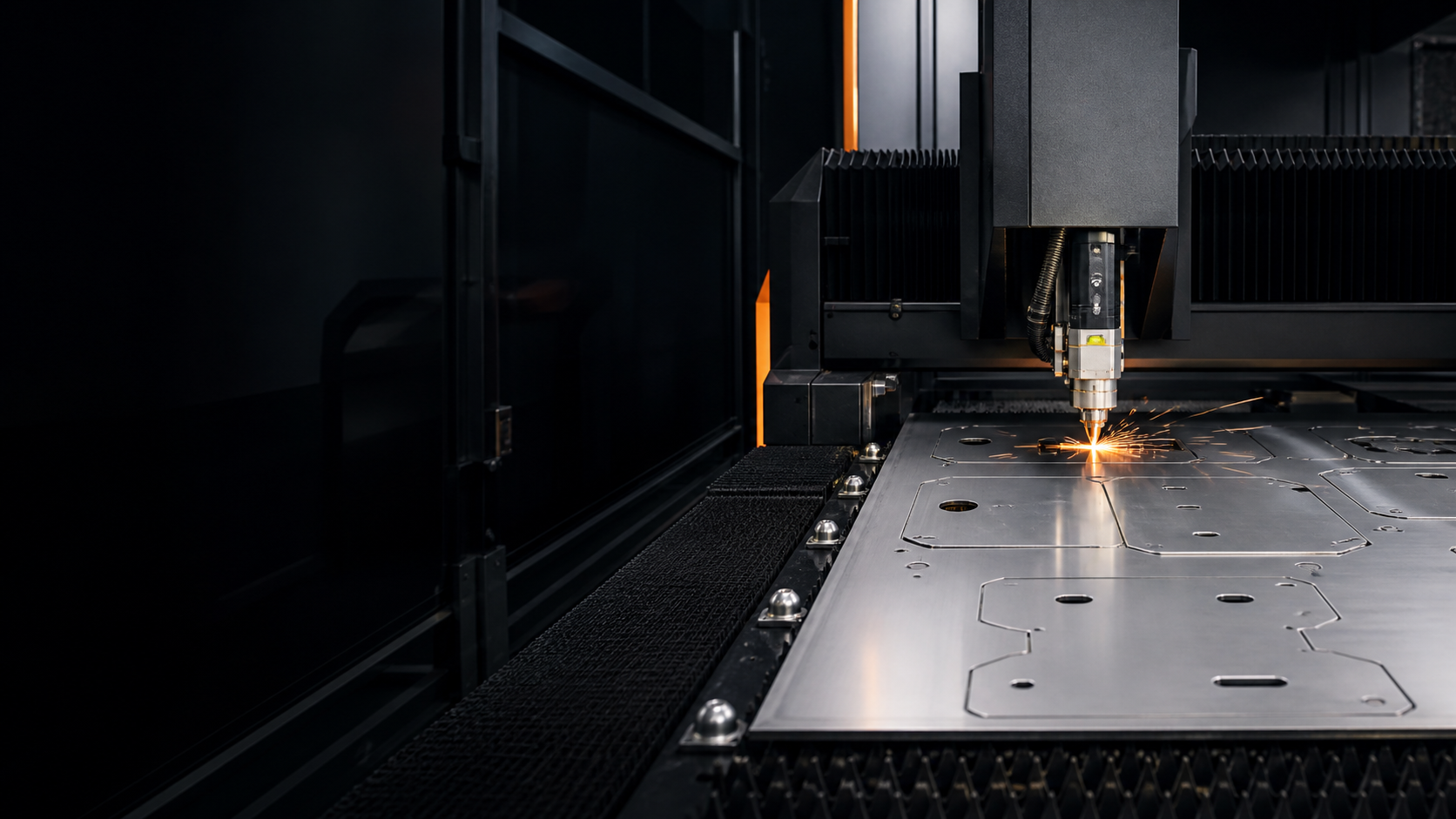
The laser supplies concentrated energy to establish the cut, but the beam is only one part of the process. Gas delivered through the nozzle helps remove molten material from the kerf. Gas type, purity, pressure, flow, nozzle condition and stand-off work together with power, focus and feed rate.
The important difference is chemical behaviour. Nitrogen is generally used as a non-reactive cutting gas: the laser melts the metal and the gas jet ejects it. Oxygen participates in an exothermic reaction with suitable steel, adding process heat while also helping remove material. TRUMPF describes nitrogen and argon as gases that do not react with molten metal in the kerf, while oxygen-assisted flame cutting uses the oxidation reaction as part of material separation.
Nitrogen vs Oxygen Laser Cutting: Engineering Comparison
The following table is a selection framework, not a guaranteed capability table. Modern high-power systems, special nozzles and mixed-gas processes can change traditional assumptions about speed and usable thickness.
| Decision factor | Nitrogen | Oxygen | What the buyer should specify |
|---|---|---|---|
| Primary mechanism | Fusion cutting: molten metal is ejected by the gas stream. | Reactive cutting: oxidation contributes additional heat. | Material grade and required cut condition. |
| Common material use | Stainless steel, aluminium and—in suitable equipment/process windows—mild steel. | Most commonly evaluated for mild/carbon steel. | Do not specify by generic “steel” alone. |
| Visible oxidation | Normally selected to minimise obvious oxide on the edge. | Produces a visibly oxidised cut edge. | State whether the edge is cosmetic or functionally critical. |
| Pressure and flow | Often relies on higher pressure and flow to eject molten metal. | Uses a different pressure and reaction-controlled process window. | Supplier selects validated settings unless the process is customer-controlled. |
| Cutting speed | Depends on power, thickness, nozzle technology and material. | Reaction can benefit selected mild-steel conditions. | Compare the actual machine/material combination, not a generic chart. |
| Edge appearance | Often brighter and preferred for exposed stainless parts. | Darker oxide is expected on mild-steel edges. | Provide an approved sample or appearance requirement where needed. |
| Downstream work | May reduce oxide-removal work, but does not eliminate deburring or cleaning. | Oxide removal may be required before some welding or coating operations. | Identify every downstream process in the RFQ. |
| Cost driver | Gas consumption and supply method may be significant. | Gas cost may be lower, but secondary edge preparation can add cost. | Compare total finished-part cost. |
How Nitrogen Laser Cutting Works
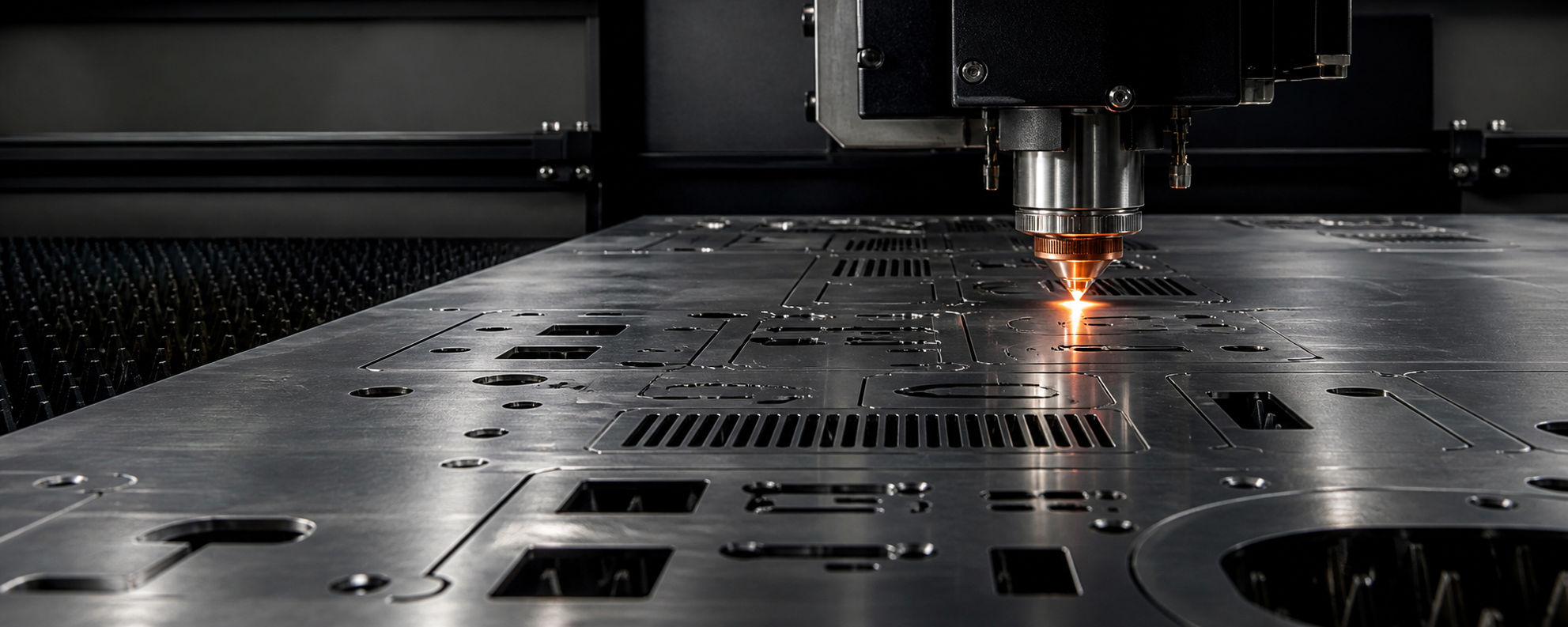
In nitrogen-assisted fusion cutting, the focused beam melts a narrow zone and the pressurised gas drives the molten metal through the kerf. Because nitrogen is selected to limit reaction with the hot cut surface, it is widely used where edge oxidation and colour matter.
That does not mean a nitrogen-cut edge is automatically perfect or ready for every next operation. Insufficient pressure, poor nozzle centring, a damaged nozzle, incorrect focus, unsuitable feed rate or inconsistent material can leave burr, adherent dross or rough striations. Gas purity and the integrity of the supply system can also influence the final edge.
Why nitrogen is often considered for stainless steel
- It can maintain a cleaner-looking edge than reactive oxygen cutting.
- It is suitable for visible stainless components where edge colour matters.
- It can reduce the oxide-removal step that might otherwise be needed before selected finishing operations.
- It supports a controlled route for parts proceeding to bending, welding, polishing or assembly.
However, nitrogen cutting is not the same as passivation, pickling, polishing or hygienic finishing. A low-oxidation cut edge does not by itself certify corrosion performance or cleanliness for a medical, food-contact, semiconductor or marine application.
Nitrogen for mild steel
High-power fiber lasers have expanded the use of nitrogen on mild steel. The commercial reason is usually to obtain a lower-oxidation edge and potentially reduce downstream preparation. Whether it is productive for a particular thickness depends strongly on the actual machine, available power, nozzle technology, nitrogen supply and required quality. It should not be described using a universal maximum thickness.
How Oxygen Laser Cutting Works
Oxygen-assisted cutting uses a reaction between oxygen and suitable steel as part of the cutting mechanism. The reaction supplies additional heat, which can support process stability or thickness capability in selected mild-steel applications. The resulting edge carries oxide; this is an expected characteristic of the process rather than proof that the part is defective.
Oxygen may be commercially sensible when the part is made from mild steel, the oxidised edge is permitted, and the later fabrication route already includes edge preparation. Examples can include concealed frame components, brackets that will be mechanically cleaned, or parts whose finishing specification explicitly accommodates the cut condition.
Oxygen should not be selected solely because its gas price appears lower. A lower machine-level gas cost can be offset by labour for oxide removal, additional handling, coating preparation, inspection or rework. Conversely, specifying nitrogen without a functional reason can add gas consumption without improving the value of the finished part.
Choosing Assist Gas for Stainless Steel
For stainless sheet, the first questions are not only grade and thickness. Buyers should also identify which edges will remain visible, whether the part will be welded, and whether polishing, passivation or another controlled surface treatment is specified.
| Stainless-steel requirement | Selection implication | Information to place on the RFQ |
|---|---|---|
| Visible enclosure, panel or trim | Nitrogen is commonly considered to limit visible oxide; an approved appearance sample may still be needed. | Visible faces, grain direction, protective film and accepted edge appearance. |
| Welded bracket or assembly | Low oxidation may reduce one preparation concern, but weld-zone cleaning and procedure requirements remain separate. | Weld process, joint location, filler/specification and cleaning requirement. |
| Polished component | Cut quality should be coordinated with the required brushed, satin or polished finish. | Finish direction, final roughness/appearance and edges to be finished. |
| Corrosion-sensitive application | Assist gas is only one part of the material and surface-control plan. | Grade, environment, passivation/pickling requirement and acceptance standard. |
| Precision assembly feature | Gas selection cannot guarantee hole size, position or fit. | Datums, tolerances and any hole requiring drilling or reaming. |
For a wider discussion of material grade and environment, see our 304 vs 316 stainless-steel guide and stainless-steel laser cutting guide for Singapore buyers.
Choosing Nitrogen or Oxygen for Mild Steel
Mild steel requires a more balanced decision. Oxygen is a well-established process choice, particularly where its reactive mechanism fits the available equipment and sheet thickness. Nitrogen may be preferable when the downstream operation benefits from a lower-oxidation edge and the machine can process the material productively.
For prototypes and low-volume production, avoiding an extra preparation step may matter more than maximising machine feed rate. For repeat work, gas consumption, cycle time, unloading, sorting and secondary labour should be compared over the whole batch. The best process can therefore change with quantity even when the drawing remains the same.
How Assist Gas Affects Welding, Coating and Finishing
Welding
An oxidised edge may need preparation before welding, depending on joint design, process, material and the applicable procedure. A nitrogen-cut edge can reduce obvious oxidation, but it should not be described as automatically weld-ready. Oil, burr, contamination, fit-up and joint preparation still require control. Projects combining cutting and fabrication can be reviewed through our welding and structural assembly service.
Powder coating and painting
Coating performance depends on the complete pretreatment system—not assist gas alone. The cut edge, scale, oil, surface profile, rinse condition and coating supplier’s procedure all matter. If oxygen cutting is proposed, clarify whether oxide removal is included and how the edge will be prepared. If nitrogen is proposed, do not assume that normal cleaning and pretreatment can be skipped.
Deburring and polishing
Gas selection can influence dross and edge appearance, but burr can occur with either route when the process window is not correct. Cosmetic stainless parts may still require blending or polishing. Our polishing and grinding capability covers project-specific edge and surface requirements.
Passivation
Passivation is a separate controlled treatment. Cutting with nitrogen does not make a stainless component “passivated,” and oxygen cutting does not by itself determine the final corrosion performance. The drawing and purchase specification should state any required post-cut chemical or surface treatment.
Edge Quality: What Should Be Inspected?
Do not accept or reject a part based only on whether the edge looks bright or dark. A useful inspection plan connects edge condition to function.
- Complete separation: no uncut bridges or incomplete contours.
- Burr and dross: assess amount, adhesion and whether removal is allowed.
- Striation and roughness: evaluate functional and visible edges separately.
- Oxide and heat colour: define whether removal is required before the next process.
- Kerf taper: consider its effect on small holes and precision features.
- Dimensions: measure against drawing datums and stated tolerances.
- Surface protection: check scratches, protective film and grain direction for appearance parts.
Our guide to laser-cut edge quality, burr, dross and striations explains defect diagnosis in more detail. For drawing requirements, use the sheet metal laser cutting design guide.
Compare Total Finished-Part Cost, Not Gas Price Alone
A quotation should account for the route needed to deliver an acceptable component. Gas can be a visible cost, especially for high-flow nitrogen cutting, but it is not the only variable.
| Illustrative scenario | Cutting-stage result | Possible downstream consequence | Commercial question |
|---|---|---|---|
| Nitrogen-cut stainless enclosure | Lower visible oxidation is targeted. | Deburring, brushing or passivation may still be specified. | Does the cleaner edge reduce preparation on the visible product? |
| Oxygen-cut mild-steel frame part | Oxidised edge is accepted at cutting. | Edge cleaning may be included before welding or coating. | Is the combined cutting and cleaning route still economical? |
| Nitrogen-cut mild-steel prototype | Lower-oxidation edge is requested. | May shorten selected preparation steps before assembly. | Does reduced rework outweigh gas use for the small batch? |
| Repeat-production mild-steel part | Both gases are technically possible. | Labour, throughput and rejection risk accumulate over the batch. | Which validated route gives the lowest repeatable finished-part cost? |
This example intentionally contains no universal per-metre rate. Material, thickness, nesting, pierces, gas supply, quantity and finishing all change the quotation. See our laser cutting cost guide for Singapore buyers for the wider pricing framework.
Application Selection Matrix
| Application | Priority questions | Likely review route |
|---|---|---|
| Automation brackets and enclosures | Are the parts bent, welded, powder coated or assembled against precision datums? | Compare edge preparation, hole requirements and batch cost. |
| Stainless instrument panels | Which edges are visible, and is brushed grain or protective film required? | Nitrogen is commonly screened first; confirm cosmetic acceptance. |
| Mild-steel machine frames | Will the cut edge be welded or coated, and is oxide removal already planned? | Compare oxygen and nitrogen as complete fabrication routes. |
| Marine or outdoor components | What grade, corrosion environment and final protective system apply? | Coordinate cutting with material and finishing specification. |
| Medical or cleanroom parts | What cleanliness, traceability and surface-treatment requirements govern the part? | Do not infer acceptance from edge colour alone. |
Assist-Gas Selection RFQ Checklist
If the gas is not mandated by an approved customer process, give the fabricator enough information to select and validate an appropriate route:
Lumen Future can review flat-sheet cutting together with downstream fabrication and inspection. Visit our metal cutting services for the wider capability overview, or send the drawing for a part-specific review.
Frequently Asked Questions
Is nitrogen or oxygen better for laser cutting?
Neither is universally better. Nitrogen is commonly selected when a low-oxidation edge has value, while oxygen can be practical for mild steel when the reactive process suits the thickness and an oxidised edge is acceptable or can be prepared later.
Why is nitrogen commonly used for stainless steel?
Nitrogen is used to help eject molten metal while limiting reaction with the hot cut surface. This normally produces less visible oxidation than oxygen cutting, which can be important for appearance and downstream processing.
Can mild steel be laser cut with nitrogen?
Yes, on suitable equipment and within a validated process window. Available laser power, sheet thickness, nozzle technology, gas supply, required edge quality and total cost determine whether nitrogen is practical.
Does oxygen cutting always produce an oxidised edge?
Oxidation is part of the oxygen-assisted cutting mechanism, so an oxide layer is expected. Its appearance and effect depend on the material and process, and the drawing should state whether it must be removed.
Does nitrogen cutting eliminate deburring?
No. Nitrogen can support a clean edge, but burr and dross still depend on focus, feed rate, pressure, nozzle condition, material and thickness. Deburring requirements should be based on the actual cut result.
Which gas is better before powder coating or welding?
A lower-oxidation nitrogen-cut edge may reduce some preparation, but it does not eliminate cleaning or process-specific pretreatment. Oxygen cutting may still be economical when oxide removal is included in the planned fabrication route.
What information is required to select an assist gas?
Provide the material grade, thickness, drawing, quantity, edge appearance, tolerances and all downstream welding, coating, polishing, passivation and inspection requirements.
Review the Complete Sheet-Metal Process
Send the material grade, sheet thickness, quantity, drawing and downstream requirements. Our team can evaluate assist gas as part of the complete cutting and fabrication route—not as an isolated machine setting.
Technical references: TRUMPF, Laser Cutting and High-Power Nitrogen Cutting; Bystronic, Gas Expertise. These sources support general process principles; actual capability and finished-part acceptance depend on the selected equipment, material and project specification.