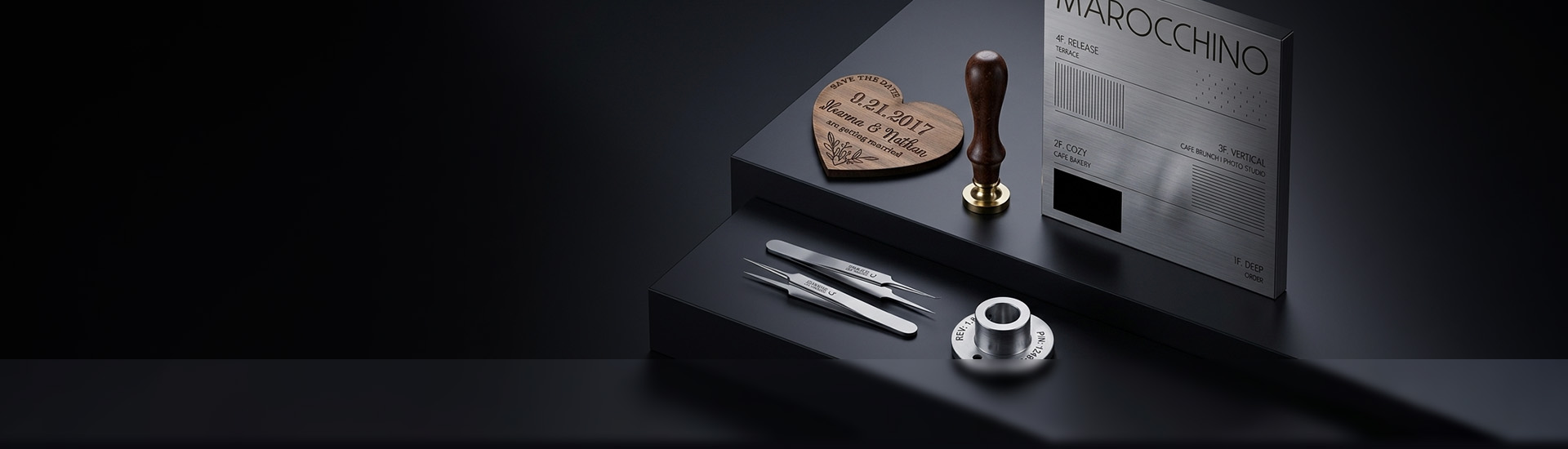
Direct part marking (DPM) applies human-readable or machine-readable identification directly to a component instead of relying only on separate packaging or a removable label. The mark may be created by laser, dot peen, scribing, electrochemical etching or another process. The correct method depends on the material, surface, required durability, code density, downstream processing, part geometry and inspection requirement. No single DPM process is best for every industrial part.
A serial number that looks clear in a photograph is not automatically a complete traceability solution. The identifier must contain the correct data, remain usable through the intended part lifecycle and be readable by the person or equipment that needs it. A marking process also has to fit the component without creating unacceptable distortion, corrosion risk, cosmetic change or production cost.
This guide explains what direct part marking means, how the main marking methods differ and what Singapore engineering and procurement teams should include in a DPM request for quotation. It is a process-selection guide rather than a claim that laser is always the answer.
What Is Direct Part Marking?
Direct part marking is the application of identification directly onto the surface of an item. The identifier may be visible text, a logo, a one-dimensional barcode, a QR Code, a Data Matrix symbol or a combination of machine-readable and human-readable information.
The meaning of DPM varies slightly between industries. Some organisations use the term only for durable marks that physically or chemically modify the surface. Others use it more broadly for any code printed directly on the part, including inkjet. For procurement purposes, it is useful to distinguish three questions:
- Is the information applied directly to the component?
- Does the process modify the surface or only deposit material?
- Must the identifier remain usable for a defined lifecycle?
GS1 describes direct part marking as applying a symbol to an item by an intrusive or non-intrusive method and supports it where component-level identification is required through the product lifecycle. The exact data structure, symbol and quality requirement still depend on the applicable system and customer specification.
Why Industrial Parts Are Marked
Production traceability
Connect a component to its batch, material, process route, inspection record or assembly history.
Service and maintenance
Identify replacement parts, maintenance intervals, manuals, asset records or configuration data.
Human identification
Show a part number, direction, warning, rating, revision or serial without requiring a scanner.
Automated identification
Allow industrial cameras or readers to associate a part with a manufacturing or inspection step.
Inventory control
Reduce confusion between visually similar parts, variants, lots or drawing revisions.
Customer requirements
Meet an approved drawing, identification system or project-specific traceability specification.
Direct marking is not universally mandatory. Regulatory and contractual requirements vary by product, industry and destination market. For example, United States FDA direct-marking requirements apply to particular medical-device circumstances, including certain devices intended for repeated use and reprocessing; they should not be generalised to every medical component. The product owner should identify the applicable requirement.
DPM vs Labels, Nameplates and Packaging Codes
| Identification route | Where the information sits | Main advantage | Main limitation |
|---|---|---|---|
| Direct part marking | On or within the part surface | Stays associated with the component without a separate carrier | May affect the surface and can be difficult to replace |
| Adhesive label | Attached to the surface | Flexible, economical and easy to replace | Adhesive, abrasion, heat or chemicals may reduce service life |
| Metal or plastic nameplate | Fastened or bonded to the part | Allows larger text, graphics and multiple information fields | Requires attachment space and can become separated from the asset |
| Packaging code | Carton, bag, tray or other packaging | Useful for logistics and stock handling | May not remain with an unpacked or assembled component |
| Digital record only | Database or system | Easy to update and store in detail | Requires a reliable physical identifier to retrieve the correct record |
Direct Part Marking Methods Compared
Laser marking and engraving
Laser processing is non-contact and can create fine text, logos, serial numbers and two-dimensional codes. Depending on the material and requirement, the process may use annealing or colour change, controlled removal of a coating, surface ablation, shallow engraving or deeper engraving.
Laser marking can support high information density and variable data, but the outcome is material- and surface-specific. Reflectivity, coating, oxide, texture, focus, part height and heat sensitivity affect contrast and geometry. A thin stainless plate, an anodised aluminium enclosure and an engineering plastic need different process routes. Review the difference between laser marking, engraving and etching before specifying mark depth, and use our metal vs non-metal laser engraving guide for the wider material comparison.
Dot peen marking
Dot peen uses a stylus to make a controlled series of indentations. It can create durable characters and Data Matrix patterns on suitable rigid parts. The mechanical indentation may be useful when depth is important, but the buyer should consider part support, noise, surface appearance, stylus wear, code density and the risk of deforming thin or stress-sensitive components.
Scribe marking and stamping
Scribe systems draw a line into the surface, while stamping displaces material with a die or individual characters. These methods can create deep, durable identification, especially on robust metal components. They are less flexible for high-density graphics and can impose mechanical loads that require proper fixturing and part review.
Electrochemical marking
Electrochemical marking uses electrical current, an electrolyte and a stencil to create a mark on a conductive material. It can be suitable for fixed text or graphics on certain metals with limited heat input. Conductivity, stencil control, surface access, chemical handling, cleaning and mark consistency should be included in the process assessment.
Inkjet and direct printing
Inkjet can apply variable information quickly without mechanically loading or thermally modifying the part. It may be suitable for production coding where the required service life and environment match the selected ink. Adhesion, curing, consumables, cleaning, abrasion, chemicals and contrast are important limitations. It should not be described as permanent without a defined durability test.
Labels and nameplates as alternatives
A label or nameplate is not a direct surface modification, but it may be the better engineering choice when information must be replaced, colour is required, the component cannot be safely marked or the available area is too small. The attachment system then becomes part of the identification design.
Quick Selection Matrix
| Method | Contact | Typical surface result | Small codes and graphics | Consumables | Important limitation |
|---|---|---|---|---|---|
| Laser | Non-contact | Colour change, ablation or engraving depending on process | Often well suited after qualification | Generally limited during marking | Material response, focus, surface and heat input |
| Dot peen | Mechanical | Pattern of indentations | Depends on stylus, dot size and surface | Stylus wear and compressed air for some systems | Noise, appearance, fixturing and part stress |
| Scribe or stamp | Mechanical | Continuous groove or displaced characters | Usually less suitable for dense graphics | Tooling wear | Mechanical load and limited data flexibility |
| Electrochemical | Surface contact | Shallow chemical/electrical mark | Controlled by stencil and process | Stencil, electrolyte and cleaning | Conductive materials and chemical control |
| Inkjet | Non-contact | Deposited ink | Possible with suitable print and reader | Ink, solvent and maintenance | Durability and adhesion depend on environment |
| Label/nameplate | Attached | No direct modification | Can support detailed graphics | Label, plate and attachment | Separation, damage or replacement control |
The table is a screening tool, not a process guarantee. Results depend on the exact material, surface finish, geometry, equipment, parameters, mark size and acceptance method.
Choose the Method from the Requirement
Mark Content: Text, Serial Numbers and 2D Codes
A DPM project should start with the data rather than a screenshot. The customer should define the approved character set, number of digits, prefixes, leading zeros, duplicate rules, batch relationship and any database connection. A code can have excellent visual quality and still fail traceability because the encoded information is wrong.
Human-readable text remains useful when an operator must identify a part without a scanner. Machine-readable symbols allow faster and more reliable data capture. Many industrial components combine a Data Matrix or QR Code with a visible serial number.
For code selection, module size, variable-data control and permanence, see our detailed guide to permanent QR Code, Data Matrix and serial number laser marking.
Designing a Readable Direct Part Mark
Readable marking depends on more than nominal outside dimensions. The design should consider:
- available marking area and clearance from edges, holes and other graphics;
- surface texture, reflectivity, colour and contamination;
- code module or character size;
- required quiet zone around a machine-readable symbol;
- curvature and variation in part height;
- reader type, working distance, angle and illumination;
- mark orientation after assembly;
- changes caused by coating, heat treatment, cleaning or wear.
GS1 DataMatrix guidance describes finder patterns, data regions, module size and quiet-zone requirements. It also distinguishes direct-part-mark quality assessment from ordinary printed-symbol assessment. Where a formal verification grade is required, the RFQ should identify the applicable standard, lighting geometry, verifier arrangement, grade and reporting scope.
When Should the Part Be Marked?
| Manufacturing stage | Possible advantage | Main question |
|---|---|---|
| Before machining or forming | Early identification through production | Will later material removal, forming or handling damage the mark? |
| After machining | Mark can reference the completed geometry | Is the marking area accessible and correctly located? |
| Before heat treatment | Supports process tracking | Will temperature and oxide change contrast or readability? |
| Before coating or anodising | The surface may protect or transform the mark | Will the finish cover, distort or reduce contrast? |
| After coating or treatment | Mark is created on the final visible surface | Will marking remove or damage required protection? |
| After assembly | Identifier can represent the finished asset | Can the marking area be reached and safely fixtured? |
Thin stainless-steel parts require additional heat-input review. See our guide to minimising heat distortion during stainless-steel laser marking. Process order should be validated on the final material and finish rather than copied from another project.
When Laser Marking May Not Be the Best Choice
Laser marking is attractive for detailed, variable and non-contact identification, but another route may be better when:
- a very deep mechanical mark is required on a robust component;
- the information must be frequently replaced;
- the part cannot be positioned within a suitable marking field;
- the available surface is highly curved, hidden or inconsistent;
- a later operation will remove or cover the marked surface;
- the material or coating has not demonstrated an acceptable laser response;
- multi-colour instructions or a large data panel are more practical on a nameplate;
- the customer requires a process already standardised around another marking method.
The best procurement decision may combine methods: a permanent direct serial on the component, a machine-readable code for automated tracking and a replaceable label or nameplate for service information.
What Singapore Buyers Should Include in a DPM RFQ
Direct part marking checklist
- Part drawing and revision
- Material and grade
- Surface finish or coating
- Part dimensions and curvature
- Mark location and orientation
- Cosmetic surface restrictions
- Required text or logo artwork
- QR, Data Matrix or barcode type
- Approved encoded data
- Fixed or variable data
- Character or symbol size
- Depth or contrast requirement
- Target reader or camera
- Verification standard and grade
- Durability exposure
- Downstream manufacturing steps
- Prototype quantity
- Production quantity
- Sampling or 100% check requirement
- Required report or record
- Packaging and Singapore delivery
For an efficient feasibility review, send the actual material and finish whenever possible. A first article should use the intended mark size, location, data and reader rather than a simplified demonstration. Lumen Future provides laser marking and engraving services in Singapore for suitable metal, coated and selected non-metal parts. Compatibility, appearance, code readability and inspection scope should be confirmed for each project.

Frequently Asked Questions
What does direct part marking mean?
It means applying human-readable or machine-readable identification directly to a component rather than relying only on its packaging or a separate removable label.
Is direct part marking the same as laser marking?
No. Laser marking is one DPM method. Other options include dot peen, scribing, stamping, electrochemical marking and, under some definitions, direct inkjet printing.
Is every direct part mark permanent?
No. Durability depends on the method, substrate, depth or adhesion, environment and downstream processing. Define permanence through a lifecycle and acceptance test.
Which DPM method is best for metal parts?
The choice depends on material, wall thickness, mark depth, code density, surface appearance, mechanical-stress limits, production volume and required durability. Laser and dot peen are common candidates, but neither is universally best.
Can Data Matrix codes be directly marked?
Yes. Data Matrix is widely used for compact industrial identification. The code design, module size, quiet zone, surface response, reader and required verification method must be agreed.
Can DPM be used on curved surfaces?
It can be possible, but curvature changes focus, module geometry, illumination and viewing angle. Submit the actual diameter, marking area and target reader for feasibility review.
How is a direct part mark inspected?
Inspection may include visual appearance, text and data checks, decoding, sequence reconciliation, dimensional checks and formal symbol verification. The required scope should be stated before quotation.
Should a part be marked before or after coating?
That depends on whether the coating must protect, reveal or avoid the mark. A coating can cover an earlier mark, while marking later can remove part of the coating. Test the complete process sequence.
Technical references
Request a Direct Part Marking Review
Send the drawing, material, finish, marking area, code or text, quantity, downstream process and inspection requirement. We can review whether laser marking is a suitable route and whether a representative first-article trial should be completed.