Laser cleaning is useful when localised removal, limited abrasive contact or controlled processing matters. Abrasive blasting is often more practical for large structural surfaces that require an anchor profile. Chemical cleaning or pickling may suit oxide removal and full-part treatment, while grinding and wire brushing remain practical for accessible, low-volume work. The correct method depends on the contaminant, substrate, required final surface, geometry, area and downstream process. No single method is best for every part.
A fair comparison of laser cleaning vs sandblasting must begin with the required result. Removing oil before welding, stripping paint from one zone, removing heavy mill scale and preparing structural steel for coating are different jobs. They may require different processes—or more than one process in sequence.
This guide compares laser cleaning, abrasive blasting, chemical cleaning and mechanical cleaning from an industrial buyer’s perspective. If you already know that laser processing fits your application and need a local supplier, see our laser cleaning service in Singapore.
Cleaning Is Not the Same as Passivation or Coating Preparation
The phrase “surface treatment” covers several operations that should not be treated as interchangeable.
| Operation | Primary purpose | Typical output |
|---|---|---|
| Cleaning | Remove oil, dirt, rust, oxide, residue or an unwanted coating | A surface free from specified contamination |
| Surface preparation | Produce the cleanliness and surface profile required for welding, bonding or coating | A defined surface condition for the next process |
| Pickling or descaling | Chemically remove oxide scale, heat tint or embedded contamination | A chemically treated metal surface that normally requires controlled rinsing |
| Passivation | Remove free iron and support formation of a passive surface on stainless steel | A chemically clean, verified stainless-steel surface |
| Coating preparation | Create the cleanliness and anchor profile required by a coating system | A surface ready for primer, paint or another coating |
A laser may remove visible oxide from an accessible stainless-steel weld, but that does not automatically prove that a passivation requirement has been met. Likewise, removing old paint does not automatically create the profile required by a new coating. The drawing, coating specification, welding procedure or applicable standard should define the final acceptance condition.
How the Four Main Cleaning Methods Work
1. Laser Cleaning
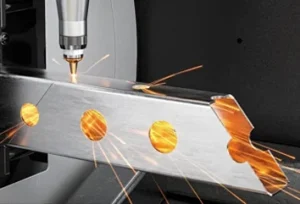
Laser cleaning directs controlled optical energy at a surface so that the target layer is heated, fractured, ejected or ablated. It avoids mechanical tool contact and can be scanned over a defined local area. Results depend on the substrate, target layer, wavelength, pulse characteristics, energy density, scanning strategy, focus and number of passes.
“Non-contact” does not mean “incapable of changing the substrate.” An unsuitable processing window may alter colour, roughness, microtexture or the underlying coating. A representative sample trial is therefore important when dimensional, cosmetic or surface-finish preservation is critical.
2. Abrasive Blasting or Sandblasting
Abrasive media is propelled against the surface to remove rust, scale or coating and to create a textured profile. Media may include aluminium oxide, garnet, glass bead, steel shot or other specified abrasives; “sandblasting” is often used as a general term, although the selected medium matters.
Blasting is widely used for large structural surfaces and coating preparation because it can remove heavy contamination while producing an anchor profile. It also produces used media, dust and removed-coating debris, and requires suitable containment, extraction, personal protection and cleanup.
3. Chemical Cleaning and Pickling
Chemical systems dissolve, loosen or react with oils, oxides, scale or contamination. The route may involve alkaline cleaning, solvents, acidic pickling, rinsing, neutralisation and subsequent passivation. Immersion can reach surfaces that a line-of-sight process cannot, including some internal passages.
The chemical formulation must match the alloy and required result. The buyer should consider bath control, dwell time, rinsing, possible etching, hydrogen-related risks where applicable, wastewater, spent chemistry and verification after processing.
4. Grinding, Sanding and Wire Brushing
Mechanical tools physically abrade the surface. They are accessible and flexible for small areas, edge preparation and local repair. Results are more dependent on tool selection, operator technique, access and tool cleanliness. Directional scratches, local overworking and transfer of contamination are possible.
For stainless steel, tooling and abrasives should be managed to avoid introducing iron contamination. For critical components, the buyer should state whether the original finish, geometry or roughness must be preserved.
Laser Cleaning vs Sandblasting, Chemical and Mechanical Cleaning
| Decision factor | Laser cleaning | Abrasive blasting | Chemical cleaning / pickling | Grinding / brushing |
|---|---|---|---|---|
| Common targets | Local rust, oxide, residue and selected coatings after trial | Rust, mill scale, coating and large-area contamination | Oil, oxide, scale and chemically removable contamination | Accessible local rust, coating, scale and residue |
| Contact with substrate | No mechanical contact; optical and thermal interaction remains | Abrasive impact | Chemical reaction | Direct mechanical contact |
| Local selectivity | Potentially strong with validated parameters and scanning | Usually requires masking for local work | Depends on chemistry, immersion and masking | Operator-controlled but difficult to make uniform |
| Surface profile | May preserve or alter roughness depending on parameters | Can intentionally create an anchor profile | May etch the surface depending on alloy and chemistry | Can create scratches and directional texture |
| Large-area work | Economics depend on scan width, layer thickness and access | Often practical for large structural surfaces | Practical where suitable tanks or spray systems exist | Labour-intensive and consistency may be difficult |
| Internal passages | Limited by line of sight and delivery-head access | Limited by nozzle and media access | Immersion may reach internal wetted surfaces | Usually poor |
| Secondary waste | Particles, fumes, coating residue and contaminated filters | Used media, dust and removed coating | Spent solutions, rinse water and sludge | Dust, removed coating and spent consumables |
| Main cost drivers | Equipment, setup, parameter trials, cycle time and extraction | Area, media, containment, cleanup and disposal | Chemistry, tanks, controls, rinsing and waste treatment | Labour, access, consumables and rework risk |
There is no useful universal “fastest” or “lowest-cost” answer. A quotation should be based on processing area, layer type and thickness, geometry, access, masking, required cleanliness or roughness, batch size, handling, extraction, disposal and inspection.
If the commercial question is whether to purchase laser equipment or use a service provider, read our separate guide: Laser Cleaning for Rust Removal: Is It Worth the Investment? That page covers ownership and outsourcing intent; this page focuses on selecting the cleaning method.
Which Method Fits Common Industrial Applications?
Precision Parts and Functional Surfaces
Laser cleaning may be considered when a bearing seat, ground face, edge, marking or surrounding finish must not be mechanically blasted. However, a trial should establish whether the selected parameters affect roughness, colour, coating or geometry. The inspection plan may include photographs, visual criteria, roughness measurement, dimensional checks or another project-specific test.
Where internal bores or complete chemical treatment are required, immersion cleaning may be more appropriate. Where the surface can tolerate a defined blasted profile, a fine abrasive process may also be viable. Critical requirements should be connected to the project’s quality and inspection plan.
Pre-Weld Cleaning
Oil, moisture, oxide and coating near a joint can contribute to welding problems. Laser cleaning can remove selected contamination from an accessible joint without abrasive media, but it does not guarantee a defect-free weld. Joint design, fit-up, consumables, shielding gas, heat input, procedure control and inspection remain important.
The supplier needs to know the alloy, contaminant, joint geometry and welding process. If fabrication and cleaning are being sourced together, link the requirement to the welding and structural assembly scope rather than treating cleaning as an isolated operation.
Moulds, Dies and Production Tooling
Laser cleaning can suit accessible mould faces where residue must be removed without direct tool contact. It is not automatically suitable for every textured, plated or polished mould. The coating, hardness, surface texture, thermal sensitivity, cavity access and fume extraction arrangement should be reviewed first.
Deep cavities, blind holes and shadowed areas may not be reachable without repositioning or disassembly. Chemical or carefully controlled mechanical cleaning may remain practical depending on the residue and tooling specification.
Structural Steel and Large Coated Surfaces
Abrasive blasting is often the more practical route for large structural surfaces, heavy scale and coating systems that require a specified anchor profile. It combines removal and profile generation in one operation, although containment, dust control, media recovery and cleanup must be considered.
Laser cleaning may still fit local weld zones, maintenance areas, edges or locations where abrasive contamination is difficult to manage. For large marine and offshore or construction and infrastructure parts, compare the complete work scope rather than the machine rate alone.
Local Mechanical Repair
Grinding and wire brushing can remain the simplest option for an accessible, low-value component where local material removal and directional marks are acceptable. Dedicated tools, suitable extraction and controlled technique improve consistency. If the project also requires blending, deburring or finish restoration, coordinate it with a polishing and grinding process.
When Laser Cleaning May Not Be the Best Choice
Laser cleaning should not be presented as a universal replacement for traditional methods. Alternative processes may be more suitable when:
- the project covers a very large structural area and requires a specified coating anchor profile;
- mill scale, corrosion product or coating is thick and removal rate dominates the economics;
- the target is inside deep holes, enclosed passages or shadowed areas that the beam and extraction cannot reach;
- the specification explicitly requires an abrasive-blast cleanliness or profile condition;
- a full-part chemical treatment or stainless-steel passivation process is required;
- the substrate, plating or layered coating has not been tested and could be affected by the laser;
- removed paint or contamination may create hazardous fumes and suitable extraction and filtration are unavailable;
- the component is low value, non-precision and can be cleaned economically with an existing manual process.
How to Specify and Inspect the Cleaning Result
A process name is not an acceptance criterion. Buyers and suppliers should agree on the result before production.
| Requirement | Questions to define | Possible verification |
|---|---|---|
| Contaminant removal | Which rust, oxide, oil, adhesive or coating must be removed? | Approved reference sample, controlled photographs or specified cleanliness test |
| Protected features | Which markings, primer, plating, dimensions or functional areas must remain? | Masking plan and before/after inspection |
| Surface finish | Is roughness preservation or a new profile required? | Roughness measurement or approved comparator |
| Downstream process | Will the part be welded, bonded, coated, passivated or stored? | Process-specific test or controlled handoff time |
| Documentation | Is a sample trial, lot record or inspection report required? | Agreed report format and sampling plan |
For sensitive surfaces, request a sample trial on a representative part or non-critical area. A trial can confirm visual result, processing access, approximate cycle time and whether additional inspection is needed. It should not be extrapolated to a different alloy, coating or geometry without review.
Industrial Surface Cleaning in Singapore
Singapore’s climate is warm and humid throughout the year. This makes the sequence between cleaning, inspection, transport, welding or coating commercially important, but it does not justify a universal claim that every steel surface will re-oxidise within a fixed number of hours.
For a Singapore project, confirm:
- whether cleaning occurs in an air-conditioned workshop, ordinary warehouse, outdoor site or marine environment;
- how long the part may wait before welding, passivation, primer or final coating;
- whether temporary corrosion protection is permitted;
- how cleaned parts will be handled, wrapped and transported;
- whether on-site work has sufficient access, electrical supply, containment and fume extraction;
- how removed coatings, dust, filters, spent abrasive or chemical waste will be classified and disposed of.
Laser cleaning avoids a liquid pickling bath and spent abrasive media, but captured dust, coating fragments and filter material still require appropriate handling. Chemical routes may generate spent acids, rinse water or sludge; the actual waste classification depends on composition. Process selection should therefore consider the entire waste stream and site controls, not a “zero waste” slogan.
RFQ Checklist for a Cleaning or Surface-Preparation Quote
Provide the following information for a meaningful process recommendation:
- base material and grade;
- part dimensions, quantity and approximate processing area;
- clear photographs of the current condition;
- type of rust, oxide, oil, adhesive, scale or coating to be removed;
- known coating composition and whether controlled substances may be present;
- areas to process and areas to protect or mask;
- features, markings, primer, plating or texture that must remain;
- required final appearance, cleanliness or roughness;
- the next operation: welding, bonding, coating, passivation, assembly or storage;
- whether a representative sample or trial area is available;
- site work or workshop processing;
- inspection and documentation requirements;
- target schedule and delivery location.
A supplier may recommend more than one process after reviewing these details. For example, a component may require mechanical removal of heavy deposits, laser cleaning of a protected zone and then an approved chemical or coating process.
Frequently Asked Questions
Is laser cleaning better than sandblasting?
Not universally. Laser cleaning can be advantageous for localised work, sensitive features and applications where abrasive media is undesirable. Sandblasting is often more practical for large areas, heavy scale and coating systems that require an anchor profile.
Can laser cleaning damage metal?
It avoids mechanical contact, but optical and thermal energy still interacts with the material. Surface colour, roughness, microtexture or a coating can change if parameters are unsuitable. Validate critical applications on a representative sample.
Does laser cleaning produce hazardous waste?
It does not use spent abrasive media or a liquid chemical bath, but it can generate particles, fumes, removed coating and contaminated filter material. The required extraction and disposal route depends on what is being removed.
Can laser cleaning replace stainless-steel passivation?
Not automatically. Laser processing may remove visible oxide from an accessible surface, while passivation is a separate chemical and verification requirement. Follow the material specification and applicable acceptance standard.
Which method is best before painting?
Use the method that achieves the coating manufacturer’s required cleanliness and surface profile. Abrasive blasting is commonly considered when an anchor profile is required. A laser process may fit local preparation, but coating compatibility and adhesion should be validated.
What is needed for a laser cleaning quotation in Singapore?
Send the material, part size, quantity, photographs, contaminant or coating, processing area, protected features, required final condition, downstream operation and whether the work is on-site or at the supplier’s facility.
Choose the Required Surface Condition Before Choosing the Method
The correct sequence is: identify what must be removed, define what must remain, specify the final surface and downstream process, then compare laser, abrasive, chemical and mechanical routes. This approach produces a more reliable quotation than selecting a process name first.
Need a Cleaning Method Review?
Send photographs, material information, the area to be cleaned and the required final condition. We can review whether laser cleaning or another process route should be considered.