304 is the workhorse — lower cost, excellent general corrosion resistance, and the right choice for most indoor or sheltered industrial applications. 316 is the marine and chemical grade — the molybdenum content provides significantly superior resistance to chloride-induced pitting, making it mandatory for any component exposed to seawater, salt air, or harsh chemical environments. In Singapore’s tropical, salt-laden coastal climate, the upgrade from 304 to 316 is often the difference between a 2-year and a 10-year service life.
1. The Chemistry Difference: What Molybdenum Actually Does
Both 304 and 316 are austenitic stainless steels — they share the same fundamental microstructure and most of the same base alloy composition. The critical difference is a single addition in 316: 2–3% molybdenum.
| Element | 304 (wt%) | 316 (wt%) |
|---|---|---|
| Chromium (Cr) | 18–20% | 16–18% |
| Nickel (Ni) | 8–10.5% | 10–14% |
| Molybdenum (Mo) | None | 2–3% |
| Carbon (C) | ≤0.08% | ≤0.08% |
| Iron (Fe) | Balance | Balance |
Molybdenum works by stabilising the passive oxide film that gives stainless steel its corrosion resistance. Without molybdenum, chloride ions (from seawater, salt air, or chlorine-based cleaning agents) can locally disrupt this passive layer, initiating pitting corrosion — a form of localised attack that creates small but deep craters that are invisible until they penetrate the full wall thickness. Molybdenum dramatically raises the critical pitting potential, making 316 the established standard wherever chloride exposure is unavoidable.
in SS316 vs 0% in SS304
temperature for SS316
premium: 316 over 304
2. 304 vs. 316 Head-to-Head
| Property | SS304 | SS316 |
|---|---|---|
| General corrosion resistance | Excellent | Superior |
| Chloride pitting resistance | Moderate | High (Mo-enhanced) |
| Seawater / salt air exposure | Not recommended | Standard marine grade |
| Chemical / acid resistance | Good for mild acids | Better for dilute acids |
| High temperature strength | Good to ~870°C | Good to ~870°C |
| Weldability | Excellent | Excellent |
| Machinability / laser cutting | Standard | Slightly harder; same process |
| Food-grade compliance | Suitable (indoor) | Preferred (cleaning chemicals) |
| Material cost | Lower baseline | ~20–35% premium |
| Availability in Singapore | Widely stocked | Readily available |
3. Why Singapore’s Environment Changes the Calculation
Material selection guides written for temperate climates often undersell the chloride risk for tropical coastal installations. Singapore’s environment presents three compounding factors that significantly favour 316 for any exposed application:
Proximity to the sea. Singapore is an island nation with extensive coastline, port infrastructure, and coastal industrial zones. Airborne salt particulate — carried inland by onshore winds — settles on exposed metal surfaces and concentrates in crevices. Even structures several kilometres from the waterfront are routinely exposed to meaningful chloride levels.
Year-round high humidity. Unlike temperate climates where surfaces dry completely between rain events, Singapore’s humidity rarely drops below 70% even at midday. Perpetual surface moisture means the electrolyte layer that enables pitting is almost always present on outdoor or semi-sheltered components.
Warm temperatures accelerate corrosion kinetics. Pitting corrosion is a temperature-dependent electrochemical process. Singapore’s average surface temperature of 30–35°C roughly doubles the corrosion rate compared to a 15°C temperate environment, even at the same chloride concentration.
“Specifying 304 for an outdoor structural application in Singapore is not a cost saving — it’s a deferred maintenance cost. The payback period on 316’s price premium is typically under three years in coastal industrial environments.”Lumen Future Engineering Team · Singapore
4. Application-by-Application Grade Selection Guide
- Indoor or climate-controlled installation
- No direct saltwater or seawater contact
- Semiconductor cleanroom components
- Electronic enclosures (indoor)
- Machine guarding and internal frames
- Food preparation surfaces (non-coastal)
- Architectural trim in air-conditioned spaces
- Cost is a primary constraint on a large volume project
- Marine, offshore, or waterfront installation
- Exposed to direct seawater, splash, or salt mist
- Chemical processing or pharmaceutical environments
- Food and beverage (regular cleaning with chlorinated agents)
- Outdoor structural brackets or handrails
- Medical device components requiring sterilisation
- Any application where part replacement is costly or disruptive
- Design life requirement exceeds 5 years in tropical exposure
5. How Grade Choice Affects Laser Cutting and Fabrication
For most standard fabrication operations — laser cutting, CNC bending, and TIG/MIG welding — 304 and 316 behave very similarly. Both are austenitic grades with comparable tensile strength, ductility, and weldability. However, there are a few practical points worth knowing:
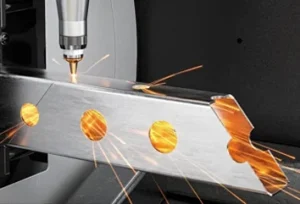
Laser cutting. Both grades cut cleanly with fiber laser and nitrogen assist gas. 316’s slightly higher nickel content makes it marginally tougher, which can require small parameter adjustments at thicker gauges, but this is transparent to the customer. Edge quality and dimensional accuracy are equivalent between grades.
Welding considerations. When welding 316, use 316L filler wire to match the low-carbon composition and prevent sensitisation — the precipitation of chromium carbides at grain boundaries that reduces corrosion resistance near the weld. Most professional fabricators apply this as standard practice, but it is worth confirming on your purchase order.
Post-weld treatment. Both grades benefit from passivation (acid pickling or electrochemical treatment) after welding to restore the full corrosion resistance of the heat-affected zone. For marine-grade 316 components, post-weld passivation should be specified explicitly — not assumed.
6. Understanding the Cost Premium — and When It’s Worth It
316 typically carries a 20–35% material cost premium over 304 at equivalent dimensions — driven primarily by the higher nickel content and the addition of molybdenum. On a large structural project, this premium is material. On a precision component, it is usually marginal relative to the machining cost.
The correct framing is not “304 vs. 316 cost” but “part cost vs. total ownership cost.” A 316 bracket that lasts 10 years in a coastal installation against a 304 bracket that requires replacement after 3 years — plus the associated downtime, labour, and logistics — is almost always the lower-cost choice over the asset’s operating life.
A practical rule of thumb: if your part is accessible and replacement is straightforward, the cost calculation for 304 is reasonable. If replacement requires scaffolding, production shutdown, or any form of confined-space access — specify 316 without hesitation.
Need Material Guidance for Your Project?
Our engineering team reviews every drawing for material suitability and DFM. Submit your files and we will advise on the optimal grade — and provide a competitive quote within 24 hours.
Submit Your Drawings →