Selective laser coating removal is not judged only by whether the target patch looks clean. A successful job must also meet the agreed boundary, preserve specified neighbouring areas and leave the underlying part in an acceptable condition. Those requirements need to be defined before a production batch is processed.
This guide is for buyers who need localised laser cleaning of coated metal components while retaining other areas. It focuses on project information, representative trials and approval, rather than comparing cleaning technologies or supplying machine settings.
Quick answer: Provide the substrate and coating details, a dimensioned removal-zone drawing, protected areas, the required removal endpoint and the next operation. Agree a representative trial and assess the cleaned zone, boundary, retained areas and substrate separately before releasing the batch.
Lumen Future’s laser cleaning service can review the proposed scope and trial requirements. Suitability depends on the actual coating system, base material, geometry and acceptance criteria; selective removal is not a blanket promise of damage-free processing for every part.
Separate Area Selection From Layer Selection
“Selective” can mean two different things. Area selection means treating a defined patch while leaving surrounding areas intact. Layer selection means removing one layer, such as a topcoat, while retaining a lower layer, such as a primer. A project may require either or both.
Confirm whether the target is bare metal, removal of a named layer or another clearly defined endpoint. Paint removal, adhesive-residue removal and oxide removal are not interchangeable specifications. State which material should disappear and which must remain.
Manufacturer literature describes both selective-area and layer-by-layer applications, but that does not establish feasibility for a particular customer’s coating stack or Lumen Future’s proposed setup. Preserving an underlying layer requires a separate review and trial. See cleanLASER’s paint-removal application overview for technology context.
This article primarily addresses regional control. Do not infer that approval to clean one patch also approves stripping the same coating to a different depth.
Mark Removal Zones, Retained Areas and the Boundary
A photograph with a circle around an area is a useful starting point, but it may not define the processing limit accurately enough. Provide a drawing with dimensions and references to identifiable edges, holes or other features.
| Zone | What to specify |
|---|---|
| Removal zone | Location, dimensions, surfaces involved and the required removal endpoint. |
| Retained area | Coatings, markings, appearance and functions that must remain acceptable. |
| Boundary or transition | Permitted positional variation, transition appearance and any prohibited encroachment. |
Identify front and back, curved surfaces, returns and repeated zones. If the part can be loaded in more than one orientation, provide an unambiguous view. A drawing revision should accompany any change to the requested area.
For illustration, a bracket might need a rectangular coating-free patch referenced from two mounting holes while retaining the surrounding finish. The patch size, endpoint and permitted transition must be defined by that project. This is not a customer case or a recommended universal boundary allowance.
Any buffer or exclusion zone should be agreed after feasibility review. Do not assume a fixed boundary tolerance, a perfectly sharp transition or that an existing paint edge is a suitable locating reference.
Provide the Substrate and Coating History
Identify the base material, thickness and relevant surface treatments. A plated, anodised or otherwise treated metal is not equivalent to an untreated substrate. Explain which underlying treatments are to be preserved.
For the coating, provide its product identity, available technical and safety data, known layer sequence and thickness information. State whether the part has been repainted, repaired, exposed to service conditions or contaminated with oil or other residues.
- Group components by known substrate and coating system.
- Identify local touch-ups or multiple coating histories.
- Show corrosion or damage beneath loose coating where visible.
- Flag unknown composition rather than guessing from colour.
- State whether trial pieces represent the actual production batch.
Two parts with the same apparent colour may not have the same layer structure or processing response. Unknown information may require additional identification or may prevent a trial from proceeding. A small successful test is not a reason to disregard composition and safety review.
Identify Nearby Sensitive Components and Access Limits
Mark seals, plastics, cables, bearings, electronics, labels and precision interfaces near the proposed treatment. Also identify holes, joints and recesses where removed material could enter or accumulate.
Explain whether the part is supplied loose or assembled, what can be removed and what must remain installed. Access for the treatment and control measures needs assessment; a visible surface is not automatically a practical processing surface.
Disassembly, isolation, shielding or masking may be needed depending on the project. Do not assume that localised treatment removes every need to protect neighbouring areas, or that processing an assembled device is equivalent to treating a bare component.
Review the coating before processing. Removed material can include particles, fumes or hazardous constituents. Qualified personnel must assess the coating information and arrange appropriate laser, exposure, extraction and waste controls. Avoiding blast media does not mean producing no waste or emissions.
TRUMPF’s application explanation includes extraction of ablated material as a system consideration. Its equipment-specific performance statements should not be treated as universal guarantees for other installations. See the TRUMPF laser cleaning overview.
Plan a Representative Trial Before Batch Approval
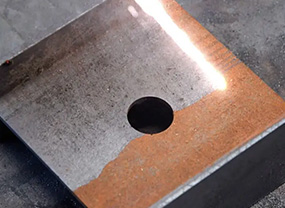
The trial should answer the actual purchasing question: can the specified zone be treated to the agreed endpoint while the protected areas and substrate remain acceptable? A clean patch far from the critical boundary may not answer that question.
Agree whether to use a spare, a rejected component suitable for testing or a specially prepared sample. A flat coupon can support initial review, but it may not represent curved surfaces, restricted access or the thermal behaviour of the real part.
- Identify the sample, substrate and coating history.
- Approve the test location and maximum authorised extent.
- Include representative edges, transitions and retained areas where relevant.
- Define the target endpoint and unacceptable changes.
- Agree stop-and-review conditions if an unexpected layer or result appears.
- Identify who reviews the sample and what records are required.
A trial is processing, not a reversible inspection. Confirm that the sample can accept the proposed alteration and that it is not a critical service part being tested without an approved disposition plan.
The trial may support proceeding, revising the specification or declining the proposed route. A feasibility review should allow those outcomes rather than treating the trial as a guaranteed demonstration of success.
Inspect Four Results Separately
For selective surface cleaning, checking only the brightest area misses much of the requirement. Use four separate acceptance questions:
| Result | Acceptance question |
|---|---|
| Removal zone | Has the specified material been removed to the agreed endpoint, including any permitted residual condition? |
| Boundary | Do position, shape and transition meet the approved drawing and criteria? |
| Retained area | Are the specified coating, markings, appearance and functions still acceptable? |
| Substrate | Are surface condition, geometry and any separately specified properties acceptable? |
Agree which items can be assessed visually and which need measurement or testing. Where specified, residual coating, roughness, adhesion or other performance characteristics need their own method, locations, acceptance criteria and reporting scope. A visual check alone cannot establish every one of these outcomes.
Photographs help document the sample and zone locations, but lighting can change apparent colour and contrast. Keep the approved physical result and inspection criteria identifiable. Avoid the word “undamaged” without stating which changes are prohibited and how they are checked.
Connect the Result to the Next Operation
Explain whether the cleared area will be welded, bonded, recoated, inspected or used for another function. That purpose helps define the required endpoint, but passing the cleaning check does not automatically qualify the next process.
For welding, retain the applicable procedure and inspection requirements; the laser cleaning for weld preparation guide addresses that workflow. For bonding or recoating, the responsible process owner should confirm surface-preparation and acceptance requirements for the actual system.
If electrical contact is the objective, appearance alone is not proof of electrical performance. Any functional test needs separate agreement rather than an inference that exposed metal will necessarily satisfy the application.
Also define handling after cleaning. Exposed surfaces may need protection from recontamination or other changes before the next operation. Agree compatible packing, storage and timing without imposing one universal processing window on every material.
Release Production Against the Approved Conditions
Record the approved sample, drawing revision, removal endpoint, retained zones and acceptance requirements. Keep the substrate and coating identification connected to that approval.
If later parts differ in coating thickness, layer sequence, substrate, repair history or geometry, review whether the trial still applies. Do not automatically extend approval to parts merely because they look similar.
Agree the production inspection extent and treatment of exceptions. A piece awaiting clarification or failing a boundary check should not be mixed with accepted parts. Confirm who authorises further treatment, rework or another disposition.
What to Send for a Selective Coating Removal RFQ
- Overall part photographs and clear views of the target areas.
- Substrate specification, dimensions, thickness and existing treatments.
- Coating identity, known layers and available technical and safety information.
- Dimensioned removal zones, reference features and protected areas.
- Nearby sensitive components, access limits and disassembly restrictions.
- Required removal endpoint and the intended next operation.
- Representative sample availability and acceptance requirements.
- Batch quantity, delivery arrangements and required timing.
For enquiries about laser paint removal on metal parts, identify unknowns clearly. Whether work can be accepted, where it can be performed and which supporting operations are included must be confirmed in the quotation. On-site service, special testing and complete assembly handling are not assumed.
Frequently Asked Questions
Can the topcoat be removed while the primer remains?
That is layer-selective removal, which needs a separate assessment of the actual coating stack and a representative trial. It is not implied by the ability to clean a selected area.
Can nearby paint always remain unchanged?
No blanket guarantee is appropriate. Define retained areas and acceptable conditions, then assess protection, access and the trial result.
Are photographs enough to define the boundary?
They help initial discussion. Critical boundaries should also have dimensions and reference features, with an agreed tolerance or transition requirement where needed.
Can an assembled component be cleaned without disassembly?
It depends on access, sensitive parts and the safety and process review. State assembly constraints before planning the trial.
Does a clean-looking surface prove it is ready for bonding or welding?
No. Cleaning acceptance and downstream process qualification are separate. The responsible process owner should define the additional requirements.
Request a Selective Cleaning Feasibility Review
Send part photographs, substrate and coating details, and a marked drawing showing removal and protected areas. Include the intended next operation and trial requirements.